Exercises and Meditations
Exercises and MeditationsPlease feel free to attach specific exercises you have found useful in your work (in general or with specific populaitons). Please do not upload attachments that are essentially full treatment manuals or protocols -- those can be uploaded here: www.contextualscience.org/treatment_protocols.
If you have developed your own exercises and tailored them for specific patients, please share them here so that the larger ACBS community may benefit from your particular take on the work, and in turn, you may find additional exercises of use to you here.
"Writing" Acceptance exercise
"Writing" Acceptance exerciseThis exercise is a fun way to help clients understand acceptance.
1st part: The clinician gives a sheet of paper and a pen to the client and says "I'm going to ask you to write a sentence if you're okay". Then the clinician puts an obstacle (a piece of carton board, for ex) in front of client's eyes and says "Wait a minute, is this annoying you if I put this in front of your eyes? Would you prefer if I'd take it off? Well I'm sorry but I'm going to let it there though. However, as you said you prefer to see while you're writing, I allow you to do everything you want to try to see what you're writing. You can move your head, you can get up... Just do everything you can to see what you're writing. Is that okay? So let's go!"
Usually, after 20 to 30 seconds the client has still not written anything readable because s/he has been too occupied with trying to avoid the obstacle so we stop the first part of the exercise. The clinician then says "How was it? Was it difficult? Have you been able to write the sentence? Can we read it?" Obviously not.
2nd part: The clinician says "Well, I'm going to propose you another approach to help you write this sentence finally. I'm sorry but I'm going to let the carton in front of your eyes again. But this time, I propose you not to try to bypass the obstacle but to concentrate your efforts on writing. Maybe it won't be easy but just do your best to write the best you can so as we will be able to read the sentence."
Generally, the client very quickly writes a sentence that we are able to read and we can debrief then. A possibility is to ask the client to write some action linked to his/her value and to write on the carton the thing s/he tries to avoid (a painful thought for ex). Also: sometimes clients or participants in workshops get the thing during the first part of the exercise (i.e. s/he stops trying to avoid the obstacle and starts writing the sentence).
This is good too because it means they understand the approach by themselves. But it can be also interesting to encourage them to do as much as possible to see while writing so as to make them observe the difference between the two approaches.
ACT EXPOSURES EXERCISE
ACT EXPOSURES EXERCISEThis worksheet provides an Acceptance based alternative to ERP, graded exposure and behavioural experiments. You can download any of our ACT, CFT or CBT resources by visiting http://www.thinkcbt.com and following the free downloads tab. We also welcome new ACT or RFT resources from other therapists. Our ACT, CFT and CBT resources are free to download and share with clinicians and members of the public.
ACT Thought Record
ACT Thought RecordAttached is an ACT take on the traditional CBT thought record. I have used this with clients and also in training workshops to illustrate one of the differences between ACT and CBT; acceptance, present moment awareness, and values vs. the 'struggle' of evidence for and against, and changing thinking.
ACT for everyday life
ACT for everyday lifeDisclaimer: This is a worksheet which is designed to be used by a therapist for therapy purposes only. The therapist using the worksheet takes full responsbility for its use and any impact of it on the client/therapy process.
Purpose of the worksheet: The aim is that the therapist works through the four steps with the client sequentially, you can break these up and divide it over a few sessions. It is most useful for people who are struggling with everyday activities, or activities of daily living (ADLs). This may be because of mood issues or physical discomfort.
Accept, Choose-Commit, Take Action Meditation
Accept, Choose-Commit, Take Action Meditation Tom LavinAcceptance physical exercise
Acceptance physical exerciseOriginally submitted by Josh Hillie:
Attached is an exercise that I transcribed from Dr. Sonja Batten's interview from “ACT in Context podcast #4” time mark 48:20 – 1:04. Overall I have found the podcast to be a great resource and very informative. Thank you to all who are doing this good work!
Important pieces for clinician to be mindful of:
1) It is important to have some kind of therapeutic bond/trust first where the client is willing to have therapist do something a bit odd/unconventional.
2) It is not about creating this grand AHA! moment, but more about the process of getting the client to understand the different ways of responding to their struggles.
3) This exercise does not have to make complete sense to the person at that very moment it was conducted. The clinician can revisit the exercise, and/or parts of it, and tie it in to later in that session, our revisit it in later sessions.
4) Therapist and client can create their own shorthand and sometimes when people can relate to things physically it can make it a little more understandable.
5) Appropriately choose your target for this type of exercise. For someone who has a significant very real trauma history you do not want to work with them to defuse or minimize their experience in anyway. Rather you might choose a medium level target, so maybe not focusing on your client’s thoughts and feelings about the traumatic event itself, but instead come up with examples about how in other ways these struggles are coming up in their lives.
Ex. An Interpersonal violence survivor where intimacy is really difficult: rather than doing this exercise with the actual thoughts, feelings, memories of the specific event itself… but instead some of the thoughts and feelings that show up when they are with their significant other or with other people who get physically close to them and it makes them physically uncomfortable. Focusing on targeting something in the here and now vs. targeting something that is related to the past trauma itself.
Acceptance Physical metaphor via Dr. Sonja Batten: ACT in Context podcast
Materials: small index cards & marker
First: Identify what person is struggling with.
Second: Once issue is identified then ask:
When dealing with ___ what’s the first thing that shows up? Client responds.
Third: When your [insert person’s response] what thought goes through your head?
Fourth: And what shows up next?
Fifth: Continue asking questions until you have 6 – 10 separate index cards with client responses pertinent to the specific struggle that they have identified.
(i.e. Thoughts?, Feelings?, Bodily Sensations?, Images that come to mind?, Memories that show up?, Urges?)
Example Script:
Client identifies struggle with Panic.
When dealing with Panic what’s’ the first thing that shows up?...My chest gets tight.
Clinician: write on index card “chest gets tight”
So when your chest starts getting tight what thought goes through your head?...I can’t take this.
Clinician: Write on a separate index card “I can’t take this”
And what Happens next? I have trouble breathing
Clinician: Writes on a separate card “Trouble breathing”
Sixth: Ask permission.
Clinician: “Would you be willing to do something a little bit odd/different/wacky with me?”
If client agrees “Yes”
Seventh: Set up 2 chairs across from each other (a couple feet apart)
Suggest if they would be open to practicing different ways to responding to these thoughts, sensations, images etc. when they show up.
Eighth: Sit in respective opposite chairs:
Clinician: “I am going to gently toss these cards one at a time over to you and what I want you to do is bat them away or move your body or do whatever you have to do to not be in touch with these cards in anyway. Clinician goes through each card one by one reads it and gently toss it over to the person…take a pause...then read next card…pause…repeat until all cards are read.
Process activity: Take time to process with the person what that experience was like.
Clinician: “How was the experience for you?”
Client: “I was a little nervous at first but I was able to batt them away and it was ok I was able to do something about it”
Clinician: “So as we were doing that do you think you would have been able to do something that was important to you at the same time?” (Adapt that to something that is important to the person that these problems have been getting in the way of)
Ex. Clinician: “Do you think while you were batting those things away could you have____ ? “ ex. done that work presentation?... read that book to your kids?,… had that important conversation with a loved one?
Client: “No, I was too focused on making sure that those cards didn’t touch me.”
Ninth: Gather the cards up with the person and tell them we are going to do this in a different way.
Clinician: “This time I want you to cover your eyes with your hands and try to distract yourself however you can. You are not going actively fight with these things but I want you to not to look at them, not to try to notice what’s going on, and just try to distract yourself as much as you can.”
Clinician goes through each card one by one reads it and gently toss it over to the person…take a pause...then read next card…pause…repeat until all cards are read.
Process activity: Take time to process with person what that experience was like.
Clinician: “What was that experience like for you?
Client: “It was sort of upsetting, I wasn’t doing anything, but after a while I was able to check out and distract myself thinking about what happened yesterday” (or whatever they were distracting themselves with during the activity)
Clinician: “And when you were in that stance would you have been able to ____?” Ex. do that work presentation?... read that book to your kids?,… have that important conversation with a loved one?
Client: “well no because I was focused on just checking out at that moment”
Note: Distraction or numbing emotions, or finding different ways to check out in the present moment, if that is your characteristic, most common, and routine way of dealing with stress or difficult situations, then that is likely to be a problem.
Experiential avoidance: It’s not that avoidance is bad per say, it’s just that when doing so creates more problems, or it can be harmful (i.e. doing drugs). Pervasive way vs. way that someone mindfully chooses to use distraction.
Tenth: Third step in this exercise gather up cards again with the client.
Clinician: “Ask you to remain in the chair with feet flat on the floor and put your arms on your lap with palms facing up in an open welcoming gesture. Would you be willing to try this a third time?"
If yes…
Clinician: "Now I am going to call out each card one at a time and gently toss these cards over to you and I want you to notice what I am saying, be present here in the moment, and keeping you open welcoming gesture can you let the cards come over and do what they are going to do?”
Clinician: goes through each card one by one reads it and gently tosses it over to the person…take a pause...then read next card…pause…repeat until all cards are read. This time the cards might fall on the persons lap, bounce off them, miss them and land at their side. Client’s job is just to be there and be present and in contact with each one of those experiences for however long it’s there.
Process activity: Take time to process with person what that experience was like.
Clinician: “So if you were in this open stance could you at the same time that these cards were coming over to you have been able to____?” Ex. do that work presentation?... read that book to your kids?,… have that important conversation with a loved one?
Client: “Yeah, at least in this stance I could get closer to it. I feel I did a little better than the other times at least.”
Purpose of activity: It is not trying to get the person to have any one particular experience but rather it’s a physical metaphor to help distinguish between the different ways that we can respond when these certain thoughts, memories, feelings, sensations come up.
a) We can try to fight them and take these active measures to control these thoughts, feelings, sensations etc. when they show up.
b) We can try to ignore, dissociate, distract, or numb and not be in touch with what’s going on.
c) Or can you be open and willing to experience whatever is there for however long it wants to stick around for. Without Holding onto it or pushing it away.
Butterfly Exercise
Butterfly ExerciseI wrote this exercise based on the "Thoughts as Butterflies" metaphor found in various ACT materials such as the "Learning ACT" book. I have used it in my ACT group and have recieved positive feedback. Feel free to comment and critique!
Spanish version submitted by Paulina Salles.
Defusion Exercises
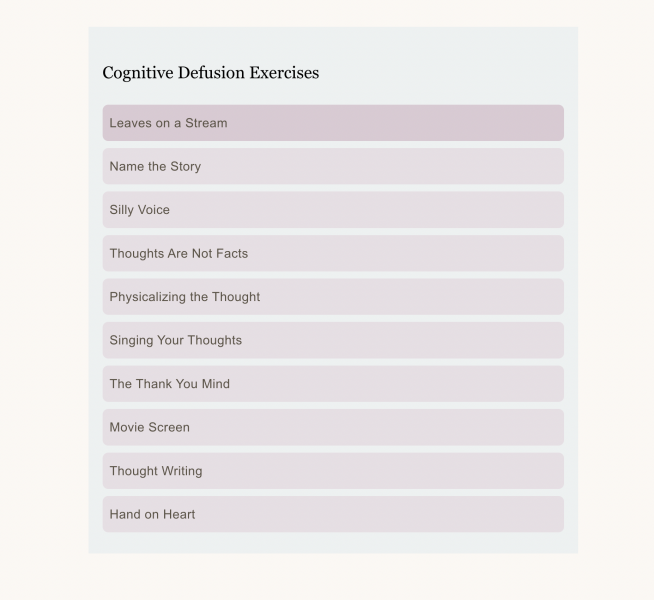
Defusion Exercises Joel Guarna10 Cognitive Defusion Exercises +FAQ
10 Cognitive Defusion Exercises +FAQ
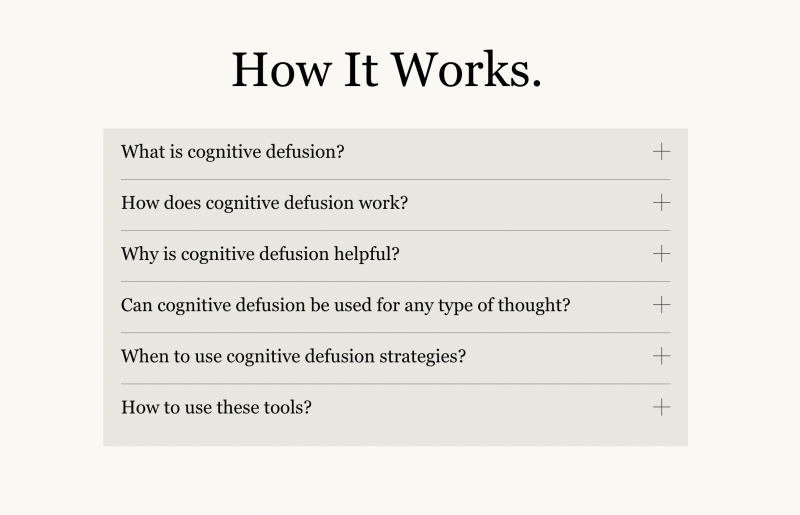
✨ Discover a curated selection of 10 cognitive defusion techniques, each crafted to help therapists assist clients in detangling from unhelpful thought patterns.
✨ Plus an FAQ section that addresses common questions, enriching your professional toolkit with clarity and ease.
10 Cognitive Defusion Exercises +FAQ
 .
. 
Airplanes - Defusion
Airplanes - Defusion Danielle PotokarFor he's a jolly good (insert X)
For he's a jolly good (insert X)Another good silly song is "for he's a jolly good fellow" including the "so say all of us". The most fun I've had with it was a client with Schizophrenia and OCD, fused with the idea that people in the shopping mall knew about an incident where he made "obscene" phone sex calls to some girls he was interested in. It was paralysing his ability to go out in public with his friends. He saw himself as a sick pervert. So we sang "For he's a jolly good pervert...." Try it - its almost impossible to get through twice without collapsing in laughter. It has considerably (but not totally) weakened the power of the idea.
Spanish version submitted by Paulina Salles:
Por qué es un buen compañero
Una canción tonta que sirve para esto es "Porque es un buen compañero", incluyendo el "y nadie lo puede negar".
Lo más gracioso que he tenido con este ejercicio fue con un cliente con esquizofrenia y el TOC, fusionado con la idea de que la gente en el centro comercial sabía acerca de un incidente en donde hizo sexo telefónico "obsceno" llamando a algunas chicas que que le interesaban. Estaba paralizando su capacidad de salir a la calle con sus amigos. Se veía a sí mismo como un enfermo pervertido.
Así que cantamos... "Porque es un buen pervertido...." Pruébelo - es casi imposible pasar dos veces sin que se hunda en la risa.
Este ejercicio debilitó considerablemente (pero no totalmente) el poder de la idea.
News of the World
News of the WorldSchool of Fish
School of Fish A cognitive defusion and acceptance exercise including instructions (see attached, pdf format). What it is (from the exercise instructions): "In some ways, our experience of anxiety is like our experience of a school of fish. Imagine a school of fish seen from a distance. What you see is a large, looming, perhaps frightening shape moving through the water. It looks more like a large fish, perhaps a shark, than a group of tiny fish... If we got closer we would see the frightening object for what it is: not an object at all, but several smaller objects occurring in about the same space at the same time. "
So Who Are You?
So Who Are You?This defusion exercise was posted by Hermann Meyer on November 29, 2006
Here is one of the best I have come accross: "So Who Are You?"
The witnessing of awareness can persist through waking, dreaming and deep sleep. The Witness is fully available in any state, including your own present state of awareness right now. So I'm going to talk you into this state, or try to, using what are known in Buddhism as "pointing out instructions." I am not going to try to get you into a different state of consciousness, or an altered state of consciousness, or a non-ordinary state. I am going to simply point out something that is already occurring in your own present, ordinary, natural state.
So let's start by just being aware of the world around us. Look out there at the sky, and just relax your mind; let your mind and the sky mingle. Notice the clouds floating by. Notice that this takes no effort on your part. Your present awareness, in which these clouds are floating, is very simple, very easy, effortless, spontaneous. You simply notice that there is an effortless awareness of the clouds. The same is true of those trees, and those birds, and those rocks. You simply and effortlessly witness them.
Look now at the sensations in your own body. You can be aware of whatever bodily feelings are present-perhaps pressure where you are sitting, perhaps warmth in your tummy, maybe tightness in your neck. But even if these feelings are tight and tense, you can easily be aware of them. These feelings arise in your present awareness, and that awareness is very simple, easy, effortless, spontaneous. You simply and effortlessly witness them.
Look at the thoughts arising in your mind. You might notice various images, symbols, concepts, desires, hopes and fears, all spontaneously arising in your awareness. They arise, stay a bit, and pass. These thoughts and feelings arise in your present awareness, and that awareness is very simple, effortless, spontaneous. You simply and effortlessly witness them.
So notice: you can see the clouds float by because you are not those clouds-you are the witness of those clouds. You can feel bodily feelings because you are not those feelings-you are the witness of those feelings. You can see thoughts float by because you are not those thoughts-you are the witness of those thoughts. Spontaneously and naturally, these things all arise, on their own, in your present, effortless awareness.
So who are you? You are not objects out there, you are not feelings, you are not thoughts-you are effortlessly aware of all those, so you are not those. Who or what are you?
Say it this way to yourself: I have feelings, but I am not those feelings. Who am I? I have thoughts, but I am not those thoughts. Who am I? I have desires, but I am not those desires. Who am I?
So you push back into the source of your own awareness. You push back into the Witness, and you rest in the Witness. I am not objects, not feelings, not desires, not thoughts. But then people usually make a big mistake. They think that if they rest in the Witness, they are going to see something or feel something-something really neat and special. But you won't see anything. If you see something, that is just another object-another feeling, another thought, another sensation, another image. But those are all objects; those are what you are not.
No, as you rest in the Witness-realizing, I am not objects, I am not feelings, I am not thoughts-all you will notice is a sense of freedom, a sense of liberation, a sense of release-release from the terrible constriction of identifying with these puny little finite objects, your little body and little mind and little ego, all of which are objects that can be seen, and thus are not the true Seer, the real Self, the pure Witness, which is what you really are.
So you won't see anything in particular. Whatever is arising is fine. Clouds float by in the sky, feelings float by in the body, thoughts float by in the mind-and you can effortlessly witness all of them. They all spontaneously arise in your own present, easy, effortless awareness. And this witnessing awareness is not itself anything specific you can see. It is just a vast, background sense of freedom-or pure emptiness-and in that pure emptiness, which you are, the entire manifest world arises. You are that freedom, openness, emptiness-and not any itty bitty thing that arises in it.
Resting in that empty, free, easy, effortless witnessing, notice that the clouds are arising in the vast space of your awareness. The clouds are arising within you-so much so, you can taste the clouds, you are one with the clouds. It is as if they are on this side of your skin, they are so close. The sky and your awareness have become one, and all things in the sky are floating effortlessly through your own awareness. You can kiss the sun, swallow the mountain, they are that close. Zen says "Swallow the Pacific Ocean in a single gulp," and that's the easiest thing in the world, when inside and outside are no longer two, when subject and object are nondual, when the looker and looked at are One Taste.
You see?
© 1999 Ken Wilber
Spanish translation submitted by Ramiro is attached.
Thoughts as Traffic Exercise
Thoughts as Traffic ExerciseThis is an excercise I created for an ACT-based anxiety group. It uses the thoughts as traffic metaphor and invites clients to do a guided cost-benefit analysis of three common responses to distracting traffic (thoughts).
Get Out of Your Mind and Into Your Life--Support Materials
Get Out of Your Mind and Into Your Life--Support Materials
This is a note from Steve Hayes about the book
I wanted to say a little about what we are learning about the impact of Get Out of Your Mind and Into Your Life
We have used or are using the book as part of our protocols in four scientific studies. The book is very flexible -- you can fit it to almost any issue, so these studies are in several different areas.
One study that is now done is Jason Lillis’s dissertation on weight maintenance. It’s a really neat study, and I predict it will get some publicity when it comes out in a journal.
In that study everyone in the ACT condition got a 6 hour workshop on ACT (not really focused on weight – but focused on doing what you value and learning to sit with difficult thoughts and feelings that get in the way). And everyone in the ACT condition also got the book.
When we then asked at the follow up if people used the book we divided up the groups into those who used it very little and those who used it regularly and carefully. We compared that last group (the readers and regular users) to people in the ACT condition who got the workshop but did not use the book much.
(In truth, in other analyses we also compared the frequent readers to the control group, and the effects there were huge, but that comparison includes the workshop in one group and not the other so it is really not as relevant to the question of whether the book itself was helpful).
At a three month follow up, those who read and used the book carefully in the ACT condition:
- Had a higher quality of life
- Were less judgmental toward themselves
- Felt less judged by others
- Were more accepting of difficult thoughts and feelings about weight issues
- Were more successful in living their values
- Had more intrinsic and less avoidant or socially compliant values
All of these folks got an ACT workshop, and the workshop itself had a really big impact – so this was over and above that. Overall (not dividing the group by whether they read Get Out of Your Mind carefully) people in the ACT condition lost more weight over 3 months, lowered their diastolic blood pressure, had better overall mental health, were more distress tolerant, and so on through a long list of good effects. But on top of that the book seemed to make an impact.
Tami Lazzarone has recently completed a randomized trial of the book with 236 teachers and staff in K - 12. At post those who read the book had small to medium improvements in general mental health, anxiety, depression, and burnout. At a 3 month follow up all of these effects were larger -- mostly medium to large. At the process level changes were found in mindfulness, acceptance, and psychological flexibility and these post changes mediated follow up outcomes.
Takashi Muto has done much the same thing with a Japanese translation of the book -- applying it to college students from Japan who are adjusting to life in the US. It is still underway but at post the effects are very good.
Anyway, let me just say this: there are a lot of books out there that say they will help you. It is one thing to say that. It is another to put a book on the line and see, objectively, how it works in controlled studies. So far the results coming in are very supportive.
BUT
How do we get everyone who buys it to read it carefully and to do the exercises? It seems to take that to make a real difference.
But probably a third of the folks who buy it will get bogged down and some will just abandon the book.
That really distresses me, since I know some of those people are suffering and could be helped if they gave the book a chance.
The bogging down may be due to my science geek writing style (I’m learning, but it is hard for me not to talk like a geek after 30 years in the University, even with a professional writer like Spencer Smith helping me). But the other part is this: this is a tricky area!
The human mind does not like being dethroned, and it is hard to use words to rein in the word machine. That is especially true in a non-interactive medium like a book.
But I do think there are steps that can help.
I suggest this if you buy this book:
- Join the list serve ACT for the Public. This is the link: https://groups.io/g/actforthepublic. It’s free. Post to it when and if you get stuck. Don’t abandon the book before you get help with it. Please.
- It is hard to really do the book carefully right off from the beginning. It takes a while to see what it is really up to.
I suggest that you skim the whole thing in a day or two, skipping the exercises and not stopping if you get confused.
Then let it sit for a day or so.
Then if you sense that there may be something of value for you in the book, open it up at page one and read it carefully, doing the exercises as you go. That process will take at least a month. If an exercise or sections bogs you down, put a post-it note there and move on … you can come back later. And you can post an email about the issue on the list serve.
I hope this helps and good luck!
Steve Hayes
Holding the Boulder of Burden - Worksheet for Chronic Pain
Holding the Boulder of Burden - Worksheet for Chronic PainThe attached worksheet, developed by Brandon Scott, has been used as a daily exercise to trigger and harness creative hopelessness for individuals with chronic pain. It has been used to help clients grow into living their life even if the pain exists.
Identifying being 'On-Track' versus 'Off-Track' in session
Identifying being 'On-Track' versus 'Off-Track' in session
I use this a lot with clients who tend to keep derailing the session. It’s incredibly powerful, and it trains defusion, acceptance, contact with the present moment, and committed action all in one simple intervention. (I wanted to put it into ACT Made Simple, but there was no space –so here it is in print for the first time).
To use this strategy, first, you need to agree that you and the client are a team - working together for a specific goal. (Obviously if the client’s goal is to get rid of their anxiety, you can’t agree to that – you just declare your helplessness; admit you don’t know how to do it in any manner that enriches life; and offer them the alternative: to ‘learn how to handle anxiety more effectively so it has less influence and impact over you’.)
So in this case you and the client might agree the goal is to have ‘more successful social interactions’, or to ‘learn how to handle anxiety more effectively so it has less influence and impact over you’, or to ‘increase social life’ etc.
Okay, that’s step one: agree on a goal, and agree you’re a team.
Step two: you say, ‘Now here’s my prediction. I could be wrong, but i predict that throughout this session, every time we start to really knuckle on down to achieving this goal, your mind is going to try and derail us; to pull us off track. And what I’d like for us to do, if you’re willing, is to identify all the different tactics your mind uses to do this; so we can spot them when they show up, and make sure we don’t get derailed by them. Is that okay?’
Step three: Therapist pulls out a large sheet of paper and a pen.
T: ‘So I’m going to write down here every tactic your mind uses. I’ll start off writing for the first few tactics, and then I’ll pass the paper over to you, and you can take over, okay?’
C: Okay
T: So what’s your mind saying now about this?
C: It won’t work.
T: Okay. Let me jot that down. ‘It won’t work’. (As the therapist says it aloud, he also writes down: ‘It won’t work’). What else?
C: This is bullshit.
T: Okay. ‘This is bullshit.’ (As the therapist says it aloud, he also writes down: ‘This is bullshit.’) What else?
C: I don’t see how this will help me.
T: Okay. ‘I don’t see how this will help me.’ (As the therapist says it aloud, he also writes down: ‘I don’t see how this will help me.’) What else?
After writing down five or six ‘derailing tactics’ - such as, ‘this is weird’, ‘but nothing has ever worked in the past’, ‘I won’t be able to do it’, - the therapist hands the paper and pen to the client.
T: So what I’d like you to do, if you’re willing, is each time your mind comes up with one of these tactics to pull us off track, just put a tick by it, so we can see how many times it shows up. Okay? And if your mind comes up with a new tactic I’ll get you to write it down, add it to the list, okay?
C: Well I can do that, but I don’t see how it’s going to help.
T: Okay, now you’ve already got that one on the list, right there: ‘I don’t see how this will help me’ – so can you place a tick by it?
(Client ticks the statement on the list)
T: See how quickly that one showed up? I bet it’s gonna come back at least another 3 or 4 times this session. Any others showing up?
C: Yeah, this is bullshit.
T: And that’s there too, isn’t it? So put a tick next to that one.
(Client ticks the statement on the list)
T: Any others showing up?
C: Yes. (smiling a little – ticks two of the other statements on the list)
As the session continues, every time the client tries to move away from the goal, the therapist calls it out as a derailing tactic and asks the client to write it down. Most clients have a repertoire of about five to fifteen tactics, and the others they come up with are just variants on these basics. At some point, the therapist is likely to need to have the following conversation:
T: Okay, so now let’s get back to that goal we agreed on.
C: There’s no point. It won’t work.
T: Is that one on the list?
C: Yes. (ticks it) But it’s true! It really won’t work!
T: Well, here’s the thing – I can’t guarantee you that it will work. In fact if you ever visit any professional who guarantees you that their treatment will work, I suggest you don’t go back to them, because they’re either bullshitting you or they’re deluded. Go to the world’s greatest surgeon for an operation and she will not guarantee you a successful outcome; she will ask you to sign a consent form in which you acknowledge all the things that could possibly go wrong. So I could show you lots and lots and lots of research on ACT to prove how effective it is with depression, anxiety, addiction, schizophrenia, you name it ... but that wouldn’t guarantee it will work for you. So here’s what I DO guarantee: I guarantee I will do my very best to help you, using the skills and knowledge that I have. I also guarantee, that if we stop the session because your mind says it won’t work, then I will be of no help to you whatsoever. So here we are – your mind is saying this won’t work – shall we let it say that and carry on, or shall we stop the session?
C: Carry on.
T: Great. So can you write down the words ‘But it really is true’ just there on your sheet, in front of ‘This won’t work’ – and put another tick by that thought, and let’s get back to the goal.
The beautiful thing about the ‘off-track, on-track’ strategy is that you are training defusion, acceptance, contact with the present moment, and committed action without even mentioning that this is what you are doing, and with minimal psycho-education – you’re just right into it. Plus, it helps the therapist defuse and stay on track.
Life Line Exercise
Life Line ExerciseThe life line exercise is an experiential metaphor to help the therapeutic dyad discuss and establish the basic ACT principles. It comes from The Art & Science of Valuing in Psychotherapy: Helping Clients Discover, Explore, and Committed to Valued Action Using Acceptance and Commitment Therapy (Dahl, Plumb, Steward, & Lundgren, 2009). This brief summary was put together as a way of teaching ACT for workshops in Sierra Leone.
Lovingkindness Meditation Script
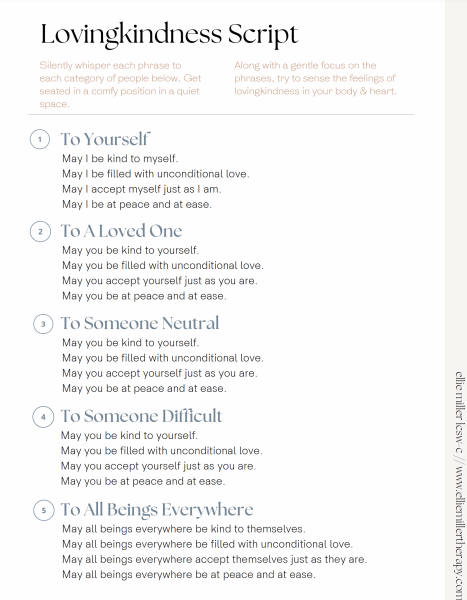
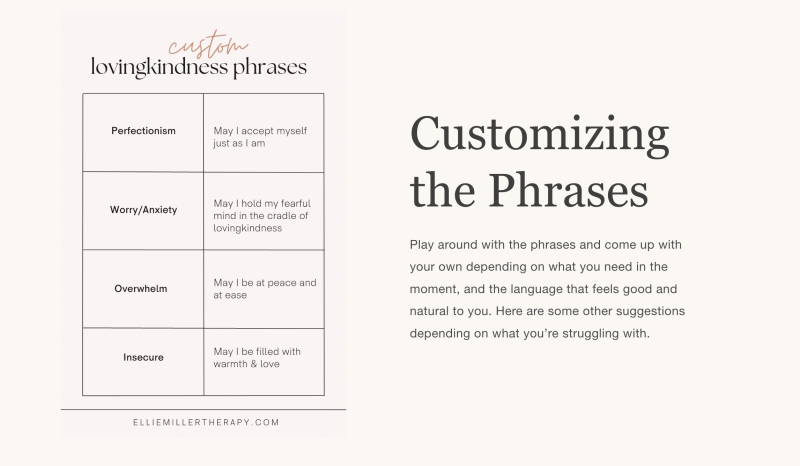
Lovingkindness Meditation ScriptLoving-kindness meditation is like a warm embrace for the mind, one that fits hand-in-glove with ACT. It’s not about pushing away the tough stuff or painting everything with a sunny sheen. Instead, it’s about opening your heart to kindness and caring—first to yourself, then to others—making it easier to handle life’s ups and downs with a grounded sense of compassion. It’s a heartfelt companion to ACT’s journey towards embracing life as it is, with all its thorns and blooms.
Lovingkindness Meditation Script PDF (and instructions)
 .
. 
Meditar
MeditarMEDITAR
MEDITARMind Sort - Initial Draft
Mind Sort - Initial DraftI put this together to help clients with defusion and self-as-context exercises; using small sticky notes or writing directly on it, clients can label their observations/emotions/predictions/evaluations. By writing these and putting them on the paper, it can serve as a direct example of letting go of our mental content.
Let me know what you think and if any additions/revisions might be helpful. I work with clients who experience psychosis, mood fluctuations, and anxiety so that was what I had in mind when I put this together.
Mindfulness for sleep
Mindfulness for sleep
It is a basic insight in ACT that irrespective what body sensations, feelings or thoughts which occupy us, we can accept that and focus on our values and chose our ACTions and behaviour accordingly.
The problem with insomnia is that sleep is not a behaviour, nothing we can “behave” but a state of consciousness. Of course we can use exercises as muscular relaxation, mindfulness focusing on the body, as body scan or breathing which can relax us an increase the tendency to fall asleep. But it is clearly stated e.g. that in body scan we shall not fall asleep but be awake. Focus on body and breath will not led all the way to sleep, because in sleep we don’t experience, at least not normally, neither the body nor the breathing.
But I think there is a mindfulness exercise, which can bring us even closer to sleep.
When we close our eyes we see, so to speak, behind our eyelids lighted and shaded areas.
If we focus on these phenomena exactly as we do in the raisin exercise, that is focus on the seeing of lighted and shaded areas in all minute details and not evaluating or thinking about what we see, it is my experience that sometimes this can lead to more picture like phenomena. And sometimes more dreamlike sequences which can lead into dream sleep and so in to the cycles of sleep.
I have tested this exercise with a few clients, one with pain often preventing sleep, and it worked sometimes.
It is my hope that others in the ACT community will find this simple exercise worth testing and even develop it further.
Jan Pilotti
M.D. Child and Adolescent psychiatrist
B.Sc. Mathematics, Theoretical physics
Örebro Sweden
PS See also the clear and valuable article Lundh, L.G. (2005). The role of acceptance and mindfulness in the treatment of insomnia. Journal of Cognitive Psychotherapy, 19, 29-39. http://contextualscience.org/Lundh_2005
I think the excercise above can be used in the broader setting which the article clearly present.
SMART Goals - improved
SMART Goals - improvedThis is a reworked version of the old acronym that I put to gether for working with Clients. Feel free to use, hope it helps your work and your Client.
Cheers,
Nik
Serene, meaningful living today
Serene, meaningful living today Tom LavinTin Can Monster exercise -- Audio files
Tin Can Monster exercise -- Audio filesAttached is the Tin-Can Monster exercise, which I recorded using the script from Get Out of Your Mind and Into Your Life. This is a really powerful willingness/acceptance exercise.
I recorded separate tracks for each experiential domain (bodily sensations, emotions, behavioral predispositions, thoughts, memories). This enables clients to repeat tracks to cycle through as many experiences in a domain as they'd like before going on to the next domain.
To go through the whole exercise just once takes a fairly long time (45 min) but people can do this acceptance work in smaller chunks over time. To download the tracks, you must first LOGIN to the site (and be a current paid member) & then when you click on the link & the dialog box appears, click "SAVE" not "play."
Values Exercises
Values Exercises80th Birthday Exercise for Values Exploration
80th Birthday Exercise for Values ExplorationOne of the classic ACT techniques for exploring values is the “imagine your 80th birthday” or the “imagine your funeral,” exercise. There are many ways to do this exercise. Attached to this page is a script showing one example of how to do this. (Be sure to be logged in with a current membership in order to download it). Enjoy!
80th Birthday exercise - therapy homework version
80th Birthday exercise - therapy homework versionThanks for creating this Doug.
I needed to give a version of this to a client this week who wants to do the writing work at home, so I edited your original to suit that format and have uploaded it here.
Feel free to offer it to your clients who like doing homework!
Batteries Exercise: Alternative to Life/Values Compass
Batteries Exercise: Alternative to Life/Values CompassThis is an alternative to the Life/Values Compass exercise and can be used to organize behavioral activation efforts.
I have used this as a metaphor when talking with clients about issues that are otherwise a bit abstract: helping connect them to the contingencies in their natural environment. Several clients have appreciated the metaphor as a simple and common language for having this discussion.
Attached, you can find it in exercise form. I would recommend doing this after you have done some other values assessment/clarification so the client has specifics in mind for each valued domain.
Digital Values Compass Tool
Digital Values Compass ToolOur Life Compass Digital Tool is here to aid ACT therapists in steering clients towards their true north. This interactive online resource simplifies the process of identifying and connecting with personal values, serving as a navigational aid in the therapeutic journey. It's an excellent addition to any ACT toolkit, providing a dynamic way to enrich sessions and empower clients' self-discovery and committed action.
→ ACT Life Values Compass Digital Tool
Trying On a Value
Trying On a ValueThis exercise is a good one for helping clients who do not have a strong sense of their values. Rather than needing to 'know' which value is important to them in order to behave, is it possible to behave for a while to learn from direct experience how it feels to a) commit to behaving consistent with a freely chosen value, and perhaps b) learn over time which values may have meaning for the person? Some work with the client around this issue (e.g., willingness, defusion/letting go of 'needing' to know the answer) will be helpful. My experience is that it's a good idea to assign this as homework for an extended period of time -- at least a few days, a week or two, or longer if possible -- to help the client build up a longer history of behaving consistently with this value before coming to any 'decisions' about continuing to move forward in the direction of that or another chosen value.
Two Sides of the Same Coin worksheet
Two Sides of the Same Coin worksheetUse this worksheet to demonstrate the two sides of the same coin metaphor. Print each slide on one side of the same piece of paper and cut out the circle. Have the client fill out their top 5 most painful internal experiences on one side and their top 5 most important values on the other. Discuss the relationship between the two sides and how you can't have one side without the other. Ask the client to turn the "painful" side up and then "get rid" of it - hide it, push it away, rip it up. Then discuss how trying to push away our painful experiences also results in pushing away our values.
Values Clarification App
Values Clarification AppI wanted to share this little gem with the greater ACT community. The Forstara Personal Values Sort for iphone and android (based on Miller,C’de Baca, Matthews, and Wilbourne's card sort exercise) has been a great way to get clients exploring their values. It takes the somewhat cumbersome task of the card sort and makes it a simple exercise anyone can complete on a smart phone in a few minutes.
Please note, the app listed above is no longer available but another has been suggested if it is of use:
Values Discovery by PanPlus Global, Inc. It’s a card sort app. https://play.google.com/store/apps/details?id=com.Pinnguaq.PPLegacyCards&hl=en
Values List & Interactive Tool
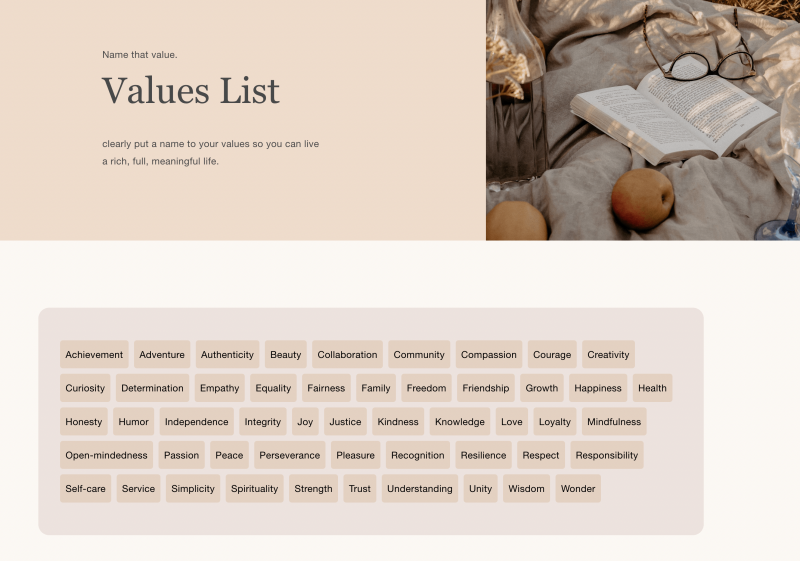
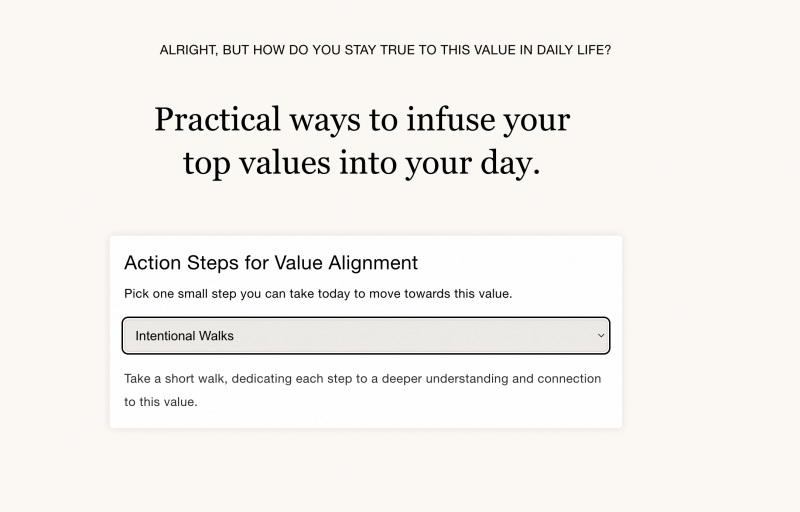
Values List & Interactive ToolI've created a downloadable Values List PDF and an Interactive Online Tool to help your clients pinpoint what's truly important to them.
These easy-to-use resources are great for guiding clients through ACT values clarification, whether as part of homework or during live sessions via screen sharing.
They're practical, straightforward, and ready to be integrated into your work. Give them a try and see how they can support your clients' progress!
→ Values List & Interactive Tool
 (2 x 2.5 in).png)
 .
.  .
.
Virtual Values Card Sort
Virtual Values Card SortPlease watch the video below (https://www.youtube.com/watch?v=U4vbz8BPS0M&feature=youtu.be) that explains the virtual values card sort and then have a play around with the PowerPoint file attached that contains the cards.
Please feel free to adapt, evolve and share the virtual values cards so that they are helpful to your context and so that other people may benefit from them too.
Please contact me at: drrichardcoates@gmail.com if you have any queries. I'd also love to hear how you get on with using them.
The virtual values card sort was a result of values-based behaviour of 'creativity, connection and learning.'
I hope they can be helpful and accessible to everyone, everywhere.
Warm wishes
Richard
Dr. Richard Coates
Clinical Neuropsychologist
UK
What Can I Control Exercise
What Can I Control ExerciseThis is an exercise adapted from Russ Harris's ACT Made Simple (Chapter 9, Drop The Struggle) as an exploration of the areas that we cannot control and developing the ability to control what we can. I ask the client to carefully circle only those phrases that describe what we can potentially control. Once they circle at least nine different phrases we discuss and process their choices. This becomes a teaching tool for exploring the concept of dropping the struggle. I usually will discuss the wisdom of the Serenity Prayer and how our work together will involve identifying and relinquishing control of what we cannot control so that we can develope (psychological flexibility) skills for what we potentially can. Whether or not the client circles incorrect responses, it tends to open the door for exploration and discussion.