Treatment Protocol and Manuals
Treatment Protocol and ManualsACT is an orientation to psychotherapy that is based on functional contextualism as a philosophy and RFT as a theory. As such, it is not a specific set of techniques. ACT protocols target the processes of language that are hypothesized to be involved in psychopathology and its amelioration, as described in the psychological flexibility model. ACT protocols are thus instances of a general intervention strategy which is designed to be flexibly applied. ACT protocols can vary from short interventions done in minutes or hours, to those that take many sessions. ACT can be used in groups, individual sessions, classroom settings, couples therapy, bibliotherapy, workplace trainings, and much more.
When an ACT strategy is applied to a given problem it can include specific interventions tailored to fit the needs and resources of the context and population -- resulting in varied protocols across populations. Furthermore, there will be variation even within protocols for specific populations based on the creativity of the researcher/clinician and relative emphasis on various ACT/RFT-sensible processes. For all of these reasons and many more, the world ACT community has chosen not to ossify the treatment through processes of centralization, certification and the like, preferring to trust its development to open an scientific processes. These include sharing of protocols, identification of processes of change, outcome research, basic research, and so on.
Protocols cited or displayed here are not the ACT approach to any given problem, but an ACT approach in the eyes of the serious researchers who post them. They are not "official" or "recognized" or approved by anyone by virtue of their posting here, but are offered as a resource to the world ACT community so that development of the approach can be accelerated. Clinical use of the protocols is the responsibility of those who choose to use them. If you plan to use these protocols in research, you should of course interact with the listed authors.
Since the ACBS community values intervention development as an empirical process, be sure to check out the latest evidence for the ACT model here.
ACBS Members: If you have an ACT treatment protocol you would like listed here, log in, and click on the "add child page" link at the bottom of this page. When adding your content, remember that you can attach relevant files and documents.
Introducing ACT to clients
Introducing ACT to clientsA brief introduction to ACT from the March 5, 2007 issue of the Sunday Telegraph in the UK
A brief introduction to ACT from the March 5, 2007 issue of the Sunday Telegraph in the UKSee attachment below
See also Spanish version submitted by Ramiro
A short introduction to ACT to be handed out after a first session
A short introduction to ACT to be handed out after a first sessionRuss Harris has this to say about the form which is attached below: I've attached a word doc of a brief summary of ACT that I give my clients on the first session. Anyone can easily re-edit it to suit their clientele. (I also usually give them a copy of the "Embracing your Demons" article; it's pitched at a level the average layperson can understand.)
Introducing Acceptance and Commitment Therapy Spanish Version
Introducing Acceptance and Commitment Therapy Spanish Version marcelogalloACT in plain language
ACT in plain languageACT in plain language Submitted by Joel Guarna on February 1, 2006 - 10:38pm. I agree that explaining ACT plainly is difficult. With my clients, I often compare and contrast ACT with CBT more generally, since CBT is more widely known. I discuss similarities and refer to some common roots to both. I then illustrate some contrasts to traditional CBT by saying that an ACT approach is "not so much about changing the content of thinking (give examples, +/- thinking, etc) or fixing 'distortions' as about changing your relationship to your thoughts, feelings, memories, and other so-called private events (relate these to their presenting issues). ACT is less about making anxiety or depression go away and more about getting you untangled from the thoughts, feelings and rxns you have and getting you (client) moving in a direction that is important to you." I give a very lay summary that ACT is related to a basic science and theory about human language and thinking (I do NOT attempt to explain RFT in much detail) and their role in our suffering (I sometimes give examples of our pain/suffering and how it differs from nonverbal animals...if the client seems interested and appears to be following). I add that, since human language seems to complicate our dealing with private events, doing ACT as a "talk therapy" is tricky: "so, if you are up for it, we will use a lot of exercises, mindfulness practice, metaphors, and other methods to keep us both from getting tangled up in the words and ideas." I try to relate all of this to their personal issues as much as possible and use examples. I discuss this in "we" terms throughout. Once their interest is piqued (& it usually is) and I am satisfied they have a sufficient grasp on the approach to give informed consent, I implore them to hold whatever "understanding" of this that they now have VERY lightly. I then try to back out of all this wordiness and shift back into a more experiential mode. The process is a difficult balancing act b/n providing enough info for informed consent and getting ahead of ourselves and getting too didactic and wordy.
Explaining ACT - A comment submitted by Nicole Rensenbrink on October 2, 2010 - 10:37am.
I have a fairly low educated clientele and teens. I'm describing treatment to them in these terms:
I use a kind of therapy (ACT) that helps people figure out what's really important to them, develop goals that'll have them live according to what's most important, and then work through the barriers that get in their way of achieving these goals. There are three typical barriers:
1) Feelings: Lots of times people can't let their feelings be what they are so they act them out or create other problems for themselves by avoiding them.
2) Thoughts: Our brains are constantly busy and people often get so wedded to what their brains are telling them that they loose sight of what's really important to them.
3) Being present: Sometimes people are so distracted or preoccupied that they aren't there enough to follow through with what's important.
So that's I'll be doing with you in counseling, if you're interested.
ACT listings as an Evidence Based Treatment
ACT listings as an Evidence Based TreatmentThis list was updated in November 2021. The State of ACT Evidence webpage has an up-to-date list.
A number of different organizations, external to ACBS, have stated that ACT is empirically supported in certain areas or as a whole according to their standards. These include:
i. American Psychological Association, Society of Clinical Psychology (Div. 12), Research Supported Psychological Treatments:
Chronic Pain - Strong Research Support
Depression - Modest Research Support
Mixed anxiety - Modest Research Support
Obsessive-Compulsive Disorder - Modest Research Support
Psychosis - Modest Research Support
For more information on what the "modest" and "strong" labels mean, click here
ii. California Evidence-Based Clearinghouse for Child Welfare (click here for the report)
Depression Treatment (Adult) - Scientific Rating 1 (Well Supported by Research Evidence)
iii. U.S. VA/DoD Clinical Practice Guideline for the Management of Major Depressive Disorder
http://www.healthquality.va.gov/guidelines/MH/mdd/MDDCPGClinicianSummaryFINAL5192016.pdf
iv. Title IV-E U.S. Department of Health and Human Services (HHS) Prevention Services Clearinghouse (under review, 2021: mental health; substance use).
v. The World Health Organization
Pain (Children and Adolescents) - WHO lists ACT as empirically supported ("moderate certainty") in the reduction of functional disability in children and adolescents with chronic pain (click here for the 2020 report).
vi. The UK National Institute for Health and Care Excellence (NICE)
Pain - NICE recommends ACT for people aged 16 years and over with chronic primary pain. (click here for the full report).
Tinnitus - NICE recommends group-based ACT for tinnitus-related distress. (click here for the full report).
vii. Australian Psychological Society, Evidence Based Psychological Interventions in the Treatment of Mental Disorders (2018):
Adults
Anxiety disorders - Generalised anxiety disorder – Level II Evidence
Anxiety disorders - Social anxiety disorder – Level II Evidence
Anxiety disorders - Panic disorder – Level II Evidence
Borderline personality disorder – Level II Evidence
Depression – Level II Evidence
Hypochondriasis – Level II Evidence
Obsessive compulsive disorder – Level II Evidence
Pain Disorders – Level II Evidence
Psychotic disorders – Level II Evidence
Substance use disorders – Level II Evidence
Binge eating disorder – Level IV Evidence
Body dysmorphic disorder – Level IV Evidence
Children (age 10-14 years)
Pain Disorders – Level II Evidence
viii. Netherlands Institute of Psychologists: Sections of Neuropsychology and Rehabilitation, Richtlijn Neuropsychologie Revalidate (2017)
The Netherlands Institute of Psychologists (NIP) recommends ACT for patients with MS with depressive symptoms
ix. Sweden Association of Physiotherapists, Fysioterapi Profession och vetenskap (2016)
The Swedish Association of Physiotherapy (physical therapy) includes ACT as a physiotherapeutic theory and practice in the definition of the profession.
x. SAMHSA's National Registry of Evidence-based Programs and Practices, ACT, last review July 2010. (NREPP was shut down in 2018, so this will not be updated unfortunately)
ACT orientation diagrams
ACT orientation diagramsIn case they are of use to anyone, I am attaching a couple of ACT orientation diagrams - variations on a theme really.
I hasten to say that these are not in any way intended to challenge the Hexaflex. Rather, they are intended for use with clients (or colleagues etc) to give a quick introduction or summary of what ACT is all about. Perhaps they might also have a role in therapy (individual or group), say in aiding discrimination training (e.g., "whereabouts on the diagram are you now?").
Get Out of Your Mind and Into Your Life (4x4) diagram:
Steve was kind enough to look at an earlier draft of this diagram which, as the name suggests, is intended to provide an overview of the book. Perhaps it could also be used as a structure for collecting client examples (e.g., pain, unworkable control attempts, etc). (I nicknamed it 4x4 because of the 4 circles and 4 arrows and it's quicker to write in the notes!) The 4 arrows of course represent 4 of the hexaflex processes, being the ACT skills enabling the client to get out of their mind (lower circles - pain/ struggle > suffering) and into their life (upper circles - values/ commitment > action).
(Putting this together made me wonder if the sequence of the arrows could suggest a sequence for the teaching of ACT skills, each building on the previous one - i.e., being in the present moment facilitating the observer perspective - in turn facilitating defusion - in turn facilitating acceptance.)
Four Cycles diagram:
Similar idea but generally a bit more detailed, though amalgamating the "self-as-context" and "being present" processes in a single "noticing" item (and a similar amalgamation - "Overthinking" - in the Struggle cycle). In this one the pivot point is in the middle ("Pain") and from there you either shuttle round the Struggle and Suffering cycles - the former specifically includes the processes associated with psychopathology according to ACT (e.g., fusion) - or, after some ACT (it is hoped), the Acceptance and Commitment cycles.
-------------------------------------------------------------------------------------
I got a bit of feedback regarding these diagrams from my ACT follow-up group today. The view seemed to be that the 4x4 diagram provides a quicker reminder of the central ACT messages, that might be more useful in times of trouble, whereas the Four Cycles looks more complicated, but might have a role when learning ACT in more relaxed contexts. On the issue of using "noticing" to represent "self-as-context" and "being present", my group felt that "noticing" has the helpful connotation of something that is readily accessible in everyday life, whereas accessing an observer self seemed to suggest something more formal and effortful - perhaps less natural in everyday life. However, it was also said that being introduced to living in the present and the observer-self separately might be better when first learning ACT, moving to the more accessible noticing concept later.
Finally, I must mention that conversations with Mark Webster have influenced the development of these diagrams, and I believe that he in turn has been influenced by the Life Manual approach of Kevin Polk and colleagues.
Comparing ACT and CBT
Comparing ACT and CBTFrom my website - https://www.joelguarna.com/:
Treatment Approaches
Cognitive-Behavioral Therapy
What is Cognitive-Behavioral Therapy (CBT)? The history of CBT dates back to the seminal work of B.F. Skinner, the father of modern behavior therapy. At that time, behavior therapy was a reaction to the traditional Freudian forms of psychotherapy that were only loosely based on scientific principles and were difficult to subject to rigorous scientific study. Skinner held psychology accountable as a science of human behavior, forever changing the face of psychotherapy. Techniques drawn from Skinner's basic behavioral science continue to be employed with good effect in modern psychotherapy. Skinner's account, however, had its limitations. The most notable limitation was that his account of human language and cognition failed to generate a vigorous line of basic research, limiting its evolution to forms that could be employed with patients with complicated psychological problems. Instead, the field opened to the work of Albert Ellis and Aaron T. Beck, the founders of modern cognitive therapy. Ellis and Beck, and their many successors, transformed the practice of psychotherapy by emphasizing therapy techniques that aimed to change the content and manner of one's thinking, not just their overt behavior. Cognitive therapy and behavior therapy continued to cross-fertilize each other over the past several decades. Modern CBT incorporates both cognitive and behavioral techniques. CBT has become the most well-known, mainstream approach to therapy, partly because it has, by far, the strongest research support for its effectiveness in treating a wide range of emotional and behavioral problems. CBT has been found effective in treating depression, anxiety disorders, the effects of trauma, substance abuse and addiction, complications related to medical conditions, and many other conditions.
Acceptance and Commitment Therapy
What is Acceptance and Commitment Therapy (ACT, said as the word "act")? ACT, just approaching its 30th anniversary since its inception, is an innovative form of behavioral and cognitive therapy that has built upon both the strengths and the weaknesses of traditional cognitive-behavioral therapy (CBT). ACT is based on a behavioral account of human language and cognition called Relational Frame Theory (RFT), which has "filled in the holes" left by Skinner's theories. RFT, in contrast to Skinner's accounts, has generated a vigorous body of basic research into human language and cognition, providing fuel for the development of new treatment approaches. The "fruit" of this progress can be found in the philosophy and basic concepts underlying ACT. ACT has moved away from the traditional CBT emphasis on changing or correcting one's thoughts in order to alleviate suffering. Instead, ACT aims to alter the functions of our private experiences (thoughts, feelings, memories, bodily reactions), so they no longer entangle us. Said another way, ACT aims to change our relationship with these private events so we can become free from their grip, and free from the patterns that bind us and prevent us from living a flexible, meaningful, and enjoyable life. In the service of these aims, ACT incorporates acceptance strategies, mindfulness techniques, and a wide range of behavioral approaches already known to be effective from CBT. ACT is one of a family of interventions inside the CBT tradition writ large that are focusing on the person's relationship to experiences rather than on the content of these experiences. The data on ACT and related approaches are moving CBT itself toward a new model that emphasizes being open, centered, mindful and actively pursuing values. Because of that, ACT and CBT as a larger tradition are becoming more difficult to distinguish over time.
Communication au symposium Pleine Conscience des 37èmes Journées Scientifiques de l'AFTCC, Paris 12 décembre 2009
Communication au symposium Pleine Conscience des 37èmes Journées Scientifiques de l'AFTCC, Paris 12 décembre 2009
Étude d'analogues expérimentaux de la restructuration cognitive et de l'acceptation sur l'émotion et la croyance dans une pensée évoquées par un souvenir douloureux
L. CORNU (1), B. PUTOIS (1), B. SCHOENDORFF (2)
(1) Université Louis Lumière, Lyon
(2) Université Claude Bernard, Lyon
Communicant : Lydie CORNU Lydie Cornu
Problématique :
Les TCC de la 3ème vague promeuvent l’acceptation plutôt que la remise en cause des pensées et émotions douloureuses. Cette étude visait à mesurer l’impact relatif d’analogues expérimentaux de l’acceptation et de la restructuration cognitive.
Méthode :
Sujets : 44 (32 après critères d’exclusion) étudiants sains de l'Université Louis Lumière Lyon.
Matériel: Une fiche dérivée de la fiche de Beck à cinq colonnes était donnée à compléter pour un groupe et une fiche similaire mais avec des instructions d'acceptation (accueillir sensations, pensées et émotions) à un deuxième groupe. Les instructions étaient également présentées au moyen d'enregistrements audio.
Procédure : Les participants, assignés de manière aléatoire à l'un de deux groupes, Restructuration ou Acceptation, étaient invités à évoquer un souvenir difficile et à l'écrire sur la fiche, avec la pensée qui leur était venue, puis à coter sur 10 leur niveau d'émotion et de croyance dans la pensée. Le commentaire les guidait à travers les étapes de
chaque condition, puis les invitait de nouveau à coter émotion et croyance, ainsi que 15 jours plus tard.
Résultats :
Une ANOVA à mesures répétées a montré un effet principal du temps sur l'émotion évoquée F(2,60)=9.85, p<.0001, sans effet de tâche. Il y avait une interaction marginale Tâche X Temps F(2,60)=3.07, p=0.0537, indiquant que l'émotion baissait plus pour le groupe acceptation relativement au groupe restructuration. Les analyses de contraste révélèrent que la seule interaction significative était entre la phase pré-test et suivi. F(1,30)=7.56, p<0.01.
Un effet principal du temps sur la croyance F(2,60)=5.9810, p<.001, sans effet principal de la tâche ni interaction Tâche x Temps indiquait qu'il n'y avait pas de différence entre les deux groupes de réduction de la croyance.
Discussion :
Cette première exploration suggère que restructuration cognitive et acceptation réduisent tant l'émotion évoquée que la croyance dans la pensée négative évoquée par un souvenir difficile. Au suivi, cette expérience suggère que l'acceptation a un impact supérieur à la restructuration sur la seule réduction du niveau de l'émotion, mais pas sur la croyance dans la pensée.
Metaphors for Introducing ACT to Clients
Metaphors for Introducing ACT to ClientsSome metaphors that can be used when introducing ACT to clients include:
These and many others are available in the Metaphors section of Resources for Clinicians.
Purpose, Privilege, Presence
Purpose, Privilege, PresenceHi All,
I did a blog on the agency website last year and wanted to share it. Sometimes, I find, that giving a client a story, having it hanging in the waiting room, helps to get a sense of what we are doing in the ACT community. Please share as you need, it is basically a "witness" to the principles we live by in our clinical offices, schools and corporations. Peace
Questions on the hexaflex for young people
Questions on the hexaflex for young peopleThis handout can be used to generate discussion and introduce ACT processes. We use it with young people (teens) but it is also an easy introduction for adult clients. Adapted from earlier hexaflex question sheets, with simpler language (and pretty colours).
At-Risk Adolescents
At-Risk AdolescentsExperimental tests to date:
None Published
For further information contact: Amy Murrell or Kelly Wilson.
Author's note: We are posting this protocol in the hope that they will provide useful information in helping clients and spark further interest and research in ACT with children and adolescents. Please, recognize that we consider the treatment technology to be evolving in nature. These protocols, therefore, should be viewed as works in progress. The underlying principles should be adhered to, but the protocols can (and indeed should) be used with flexibility.
The protocol is attached to this page. Log into your ACBS member account to view/download the file.
Agoraphobia
AgoraphobiaAn ACT protocol designed for use with agoraphobia. Experimental tests to date: Hayes, S. C., Wilson, K. G., Afari, N., & McCurry, S. (November 1990). The use of Acceptance and Commitment therapy in the treatment of agoraphobia. Paper presented at meeting of the Association for the Advancement of Behavior Therapy, San Francisco. This is a very early anxiety protocol, written about 18 years ago. There has been a lot of work since on ACT for anxiety and though it is still recognizably the same kind of protocol, it has gotten better as we've gone along. For an excellent and detailed ACT anxiety protocol see the book by Eifert and Forsyth, 2005. Acceptance and Commitment Therapy for anxiety disorders. Oakland: New Harbinger. For further information contact: Steve Hayes (hayes@unr.edu), Department of Psychology, University of Nevada, Reno, NV 89557-0062.
"ACT For Life" - Group Intervention for Psychosis Manual
"ACT For Life" - Group Intervention for Psychosis ManualACT For Life Intervention
The intervention consists of four, two-hour weekly group sessions. The intervention is based principally around the “Passenger on the Bus” metaphor (Hayes, Strosahl, & Wilson, 1999), which is used to provide a consistent narrative thread throughout the groups. We use the metaphor to explore issues of workability, fusion, mindfulness, values and committed action in each of the sessions. We emphasise choice around participation, saying from the outset that, we would like people to participate as much as possible but it is an equally valid option to sit out of exercises. However, we generally find participants enjoy the interactive aspects of the group and often comment afterwards that the role playing is often one of the more memorable aspects of the group.
From the first group, we ask participants to be setting values goals that they can work towards throughout the week. However, we are careful to emphasise process goals here rather than outcome goals. As such, we frame this as an opportunity for participants to notice “passengers” or obstacles that arise as they approach the activity, and if the activity is completed, this is simply an added bonus.
We use PowerPoint presentations to make the groups more interactive and provide further structure to the groups. We have found this particularly useful in working with younger clients. The video vignette of the story of Tom can be downloaded from here: https://dl.dropbox.com/u/20036241/Tom_vignette_ACT_for_Life_groups.avi
The groups are designed to for approximately 8-10 participants. In each group we would have two to three therapists working with the group.
Each session follows a similar structure, which includes:
1. Warm-up exercise
2. Noticing (mindfulness exercise)
3. Discussion of the out of session activity from the previous week
4. Group discussion/ activity
5. Planning out of session activity
6 Session ACT Toolkit
6 Session ACT ToolkitThank you to everyone who has expressed interest in the toolkit. In order to effectively distribute the most up-to-date version of the toolkit, we have created a website for you and your clients to access:
The toolkit compiles information from around the web for psychoeducational and therapeutic use with clients. It also includes several exercises and worksheets designed by the creators. The website hosts the client version, and a Clinician Guide can be found here: http://www.helpwithact.com/toolkit
A training video of the creators reviewing the toolkit and how to use it can be accessed here: https://www.youtube.com/watch?v=Hu3f6UpUZJw
Please contact the creators with any questions or feedback.
ACT For Gambling Disorder
ACT For Gambling DisorderThis toolkit compiles information from around the web for psychoeducational and therapeutic use with clients. It also includes several exercises and worksheets designed by the creators. Please contact the creators with any questions or feedback.
The file can be accessed in its current form here:
https://docs.google.com/document/d/1hr3jsIE4RiiMPzY0EUIBxGyw-BwKI8r_pEcmmrALd7E/edit?usp=sharing
ACT For Grief (English Draft And Farsi Protocol)
ACT For Grief (English Draft And Farsi Protocol)ACT For Kids: Living a Valued Life
ACT For Kids: Living a Valued LifeThis ACT for Kids manual was developed by Steven Gordon, Michael Asher, and Michael Selbst.
Please note: due to copyright laws, ACBS removed images from the document. Therefore, some of the formatting might be slightly off.
ACT For Sleep Problems
ACT For Sleep ProblemsThis protocol was developed by Lindsay Fletcher at the University of Nevada, Reno. This protocol was developed by Lindsay Fletcher at the University of Nevada, Reno. Contact Lindsay for more information.
ACT Groups for Partial Hospitalization/Intensive Outpatient Programs (PHP/IOP)
ACT Groups for Partial Hospitalization/Intensive Outpatient Programs (PHP/IOP)I work in the Birches Program at the Brattleboro Retreat in Southern Vermont, a Partial Hospitalization/Intensive Outpatient Program (PHP/IOP). Participants usually stay in our program four to six weeks. I have developed a set of a dozen ACT-based groups that are inter-related and mutally supportive. Themes of: mindfulness; compassion; matrix; defusion; acceptance; anger; assertiveness; self-care; healthy relationships; finding motivation; values and action. Partcipants also have daily check-in groups that are more freely structured. I facilitate these themes on a rotating basis. I don't recommend them as stand-alone processes. I got most of the practices and metaphors from ACT trainings and books; if there is anything original, it's how I've sequenced things (and how I interact with the participants, with humor and on equal footing). I hope you will find these write-ups helpful.
Charlie Laurel, MS, LCMHC
ACT Made Simple: Togus One Week Protocol
ACT Made Simple: Togus One Week ProtocolAttached is a more developed version of the Togus one-week protocol. Kevin Polk presented the sketch of this at ACT SI III. Dr. Hambright has developed it further. Email Kevin if you have questions. polkkev@gmail.com.
Click here for the newest version of the protocol
Additional materials are routinely updated on Kevin Polk's blog
Noticing Hooks and What You Do Next
Noticing Hooks and What You Do Next
Togus Protocol 5/24/10
Togus Protocol 5/24/10Attached is a pdf of the latest 5-day (12 session) Togus PTSD Intensive Outpatient Program.
Email me with questions.
Kevin
Kevin Polk, Ph.D.
ACT ON HEALTH: An ACT group programme for weight management
ACT ON HEALTH: An ACT group programme for weight managementThis is a 6-session group programme designed for use in in a secure hospital setting, although the content could be used and adapted for other settings. It was written in response to the fact that many service users who are mandated to stay in hospital rapidly put on weight as a consequence of various factors including leading a sedentary lifestyle, prescribed medication, lack of control over hospital food choices, and comfort eating. Whilst there is often very good advice available about healthy eating and exercise, many service users seemingly choose not to follow this advice. We hypotheseised that this may be due to remoteness from values, and/or patterns of cognitive fusion and experiential avoidance. The resulting programme represents an attempt to draw attention to these processes in the service of making choices that were more mindful and more value-driven.
I would like to acknowledge the 'Obesity Stigma and Weight Management Acceptance and Commitment Therapy Treatment Manual', which is a one-day workshop protocol developed by Jason Lillis, Steven Hayes, and Kara Bunting. This is also available on the ACBS website and was a big part of the inspiration for our work.
Please contact Richard Bennett via info@thinkpsychology.co for more information.
ACT Self Help and the World Health Organization: "Doing What Matters in Times of Stress" and Self-Help Plus (SH+)
ACT Self Help and the World Health Organization: "Doing What Matters in Times of Stress" and Self-Help Plus (SH+)The World Health Organization (WHO) decided around 2015 to test ACT as a fully scalable psychological intervention. Dr. Mark van Ommeren, head of Mental Health, was looking for a radically transdiagnostic approach that could help with the wide variety of mental and behavioral consequences of war. The breadth of outcomes across different problems areas world wide for ACT attracted his attention. The war in the South Sudan was a particular issue at the time and Van Ommeren was aware that ACT had been deployed in Sierra Leone by the "Commit and ACT" clinic in Bo. ACT was proving helpful in the ebola outbreak there. Dr. Ommeren consulted with leaders of the ACT community (including Steve Hayes), asking for ideas of how best to simplify ACT and was referred to the work of Russ Harris. Van Ommeren was especially impressed with the simplicity of Russ Harris Illustrated Happiness Trap and Russ agreed to work with the WHO team to produce what became Doing What Matters in Times of Stress ("DWM"; 2020) -- an illustrated guide to ACT ideas stated in very non-technical language with graphical images.
WHO does not distribute health care advice until it is rigorously tested in a series of high quality randomized trials, beginning with very careful pilot work. These evaluation studies are deliberately conducted with developers held at arms length. If the methods are helpful they are then distributed for free. At the time, WHO had no fully scalable psychological interventions in its portfolio that could be distributed without the involvment of highly trained professionals. Over a period of 4-5 years ACT self-help was tested both in the simplest way (distributing the book, wih some minimal addition supports) and with the lessons in the book being described in audiotapes and discussed in a small group format by non-specialists in a program called "Self-Help +" ("SH+"; Brown et al., 2018; Tol et al., 2018).
ACT self-help successfully passed through these tests of efficacy across a range of settings, cultures, language communities, and problem areas. SH+ reduced anxiety and depression with war refugees at a level that was similar to self-help in economically privileged societies (Tol et al., 2020; Turrini et al., 2022), and reduced future development of mental health disorders by nearly by half over a year's time (Purgato et al., 2022). Importantly, increases in psychological flexibility were shown to mediate these changes (Lakin et al., 2023). Said simply, the evaluation studies suggested that ACT works and works via its putative processes of change.
Doing What Matters in Times of Stress is now distributed by WHO on a website that describes it in unusually broad terms: "Informed by evidence and extensive field testing, the guide is for anyone who experiences stress, wherever they live and whatever their circumstances." As an example of that view, when the COVID pandemic hit and WHO did not have an evidence-based approach for that problem, people were referred to that page https://www.who.int/publications/i/item/9789240003927 and studies were quickly conducted on DWM and SH+. The data showed that stressed health care workers were indeed helped (Riello et al., 2021; Mediavilla et al., 2023). Similarly WHO is now actively disseminating ACT self-help in the Ukraine to help with war survivors. Data are being collected there but it is not yet published.
ACT self-help is increasingly being built into the fabric of global health at WHO. In 2023 in an invited plenary talk at the World Congress of Cognitive and Behavioral Therapies in Seoul, Korea, WHO Mental Health head van Ommeren said that Doing What Matters in Times of Stress was now the most downloaded physical or mental health document of any kind at the World Health Organization.
SELF-HELP PLUS (SH+) (2021)
A group-based stress management course for adults (World Health Organization)
https://www.who.int/publications/i/item/9789240035119
Overview
Self-Help Plus (SH+) is WHO’s 5-session stress management course for large groups of up to 30 people. It is delivered by supervised, non-specialist facilitators who complete a short training course and use pre-recorded audio and an illustrated guide (Doing What Matters in Times of Stress) to teach stress management skills. The course is suitable for adults who experiences stress, wherever they live and whatever their circumstances. It has been shown to reduce psychological distress and prevent the onset of mental disorders. The format of SH+ makes it well-suited for use alongside other mental health interventions, as a first step in a step.
Available in English, Arabic, Juba Arabic, French, Portuguese, Spanish, Turkish, Ukrainian.
Doing What Matters in Times of Stress (2020)
An Illustrated Guide
https://www.who.int/publications/i/item/9789240003927
https://iris.who.int/handle/10665/331901
Overview
Doing What Matters in Times of Stress: An Illustrated Guide is a stress management guide for coping with adversity. The guide aims to equip people with practical skills to help cope with stress. A few minutes each day are enough to practice the self-help techniques. The guide can be used alone or with the accompanying audio exercises.
Informed by evidence and extensive field testing, the guide is for anyone who experiences stress, wherever they live and whatever their circumstances.
Available in Arabic, Armenian, Chinese, Czech, Dari, English, Estonian, Farsi/Persian, Finnish, French, German, Georgian, Greek, Hungarian, Indonesian, Italian, Japanese, Juba Arabic, Korean, Lithuanian, Malay, Polish, Portuguese, Romanian, Russian, Slovak, Spanish, Swedish, Tigrinya, Tongan, Turkish, Ukrainian, Urdu, Vietnamese.
How to Use WHO Self-help Plus Protocol
Webinar presented by Russ Harris and Claudette Foley
April 13, 2022
https://contextualscience.org/video/how_to_use_who_selfhelp_plus_protocol_webinar
Overview
This is a webinar on WHO's ACT protocol for refugees. We will answer Frequently Asked Questions about the protocol–also known as “Self-help Plus”-and explore how to implement it.
References:
Lakin, D. P., Cooper, S. E., Andersen, L., Brown, F. L., Augustinavicius, J. L. S., Carswell, K., Leku, M., Adaku, A., Au, T., Bryant, R., Garcia-Moreno, C., White, R. G., & Tol, W. A. (2023). Psychological flexibility in South Sudanese female refugees in Uganda as a mechanism for change within a guided self-help intervention. Journal of Consulting and Clinical Psychology, 91(1), 6–13. DOI: 10.1037/ccp0000774
Mediavilla, R., Felez-Nobrega, M., McGreevy, K. R., Monistrol-Mula, A., Bravo-Ortiz, M. F., Bayón, C., ... & Ayuso-Mateos, J. L. (2023). Effectiveness of a mental health stepped-care programme for healthcare workers with psychological distress in crisis settings: A multicentre randomised controlled trial. BMJ Mental Health, 26(1), 1-8. DOI: 10.1136/bmjment-2023-300697
Acarturk, C., Uygun, E., Ilkkursun, Z., et al. (2022). Effectiveness of a WHO self-help psychological intervention for preventing mental disorders among Syrian refugees in Turkey: A randomized controlled trial. World Psychiatry, 21, 88–95. DOI: 10.1002/wps.20939
Acarturk, C., Kurt, G., Ilkkursun, Z., Uygun, E., & Karaoglan-Kahilogullari, A. (2022). “Doing What Matters in Times of Stress” to decrease psychological distress during COVID-19: A randomised controlled pilot trial. Intervention, 20(2), 170-178. DOI: 10.4103/intv.intv_29_21
Turrini, G., Purgato, M., Tedeschi, F., Acartürk, C., Anttila, M., Au, T., et al. (2022). Long-term effectiveness of Self-Help Plus in refugees and asylum seekers resettled in Western Europe: 12-month outcomes of a randomised controlled trial. Epidemiology and Psychiatric Sciences, 31, E39. DOI: 10.1017/S2045796022000269
Purgato, M., Carswell, K., Tedeschi, F., Acarturk, C., Anttila, M., Au, T., Bajbouj, M., Baumgartner, J., Biondi, M., Churchill, R., Cuijpers, P., Koesters, M., Gastaldon, C., Ilkkursun, Z., Lantta, T., Nosè, M., Ostuzzi, G., Papola, D., Popa, M., Roselli, V., Sijbrandij, M., Tarsitani, L., Turrini, G., Välimäki, M., Walker, L., Wancata, J., Zanini, E., White, R., van Ommeren, M., & Barbui, C. (2021). Effectiveness of Self-Help Plus in preventing mental disorders in refugees and asylum seekers in Western Europe: A multinational randomized controlled trial. Psychotherapy and Psychosomatics, 90, 403–414. DOI: 10.1159/000517504
Riello, M., Purgato, M., Bove, C., Tedeschi, F., MacTaggart, D., Barbui. C., & Rusconi, E. (2021). Effectiveness of self-help plus (SH+) in reducing anxiety and post-traumatic symptomatology among care home workers during the COVID-19 pandemic: A randomized controlled trial. Royal Society of Open Science, 8, 210219. DOI: 10.1098/rsos.210219
Tol, W.A., Leku, M.R., Lakin, D.P., Carswell, K., Augustinavicius, J., Adaku, A., Au, T.M., Brown, F.L., Bryant, R.A., Garcia-Moreno, C., Musci, R.J., Ventevogel, P., White, R.G., van Ommeren, M. (2020) Guided self-help to reduce psychological distress in South Sudanese female refugees in Uganda: a cluster randomised trial. Lancet Global Health, 8(2), e254–63. DOI: 10.1016/S2214-109X(19)30504-2
Tol, W. A., Augustinavicius, J., Carswell, K. Adaku, A. M., Leku, R., Brown, F. L., Garcia-Moreno, C., Ventevogel, P., White, R. G., Kogan, C.S., Bryant, R. and van Ommeren, M. (2018). Feasibility of a guided self-help intervention to reduce psychological distress in South Sudanese refugee women in Uganda. World Psychiatry, 17(2), 234-235. DOI: 10.1002/wps.20537
Tol, W. A., Augustinavicius, J., Carswell, K., Brown, F. L., Adaku, A. M., Leku, R., Garcia-Moreno, C., Ventevogel, P., White, R. G. and van Ommeren, M. (2018). Translation, adaptation, and pilot of a guided self-help intervention to reduce psychological distress in South Sudanese refugees in Uganda. Global Mental Health. DOI: 10.1017/gmh.2018.14
Brown, F. L., Carswell, K., Augustinavicius, J., Adaku, A., Leku, M. R., White, R. G., Ventevogel, P., Kogan, C. S., García-Moreno, C., Bryant, R. A., Musci, R. J., van Ommeren, M., & Tol, W. A. (2018). Self Help Plus: study protocol for a cluster-randomised controlled trial of guided self-help with South Sudanese refugee women in Uganda. Global mental health, 5, e27. DOI: 10.1017/gmh.2018.17
Epping-Jordan, J., Harris, R., Brown,F.L., Carswell, K., Foley, C., García-Moreno, C., Kogan, C., & van Ommeren, M. (2016). Self-Help Plus (SH+): a new WHO stress management package. World Psychiatry, 15, 295-296. DOI: 10.1002/wps.20355
ACT Treatment Outlines for Anxiety and Depression (Forman et al., 2007 effectiveness study)
ACT Treatment Outlines for Anxiety and Depression (Forman et al., 2007 effectiveness study)This page includes treatment outlines that were used in the Forman and colleagues (2007) effectiveness study comparing ACT and CT for anxiety and depression.
Please note (From Sue Orsillo): The research manual referenced in the Anxiety Outline attached below is no longer distributed since the publication of the book Mindfulness and Acceptance-based Behavioral Therapies in Practice. The book is intended to serve as a "clinical manual". The research protocol was an in-house protocol that states which questionnaires should be handed out in each session for the study, etc. That manual assumes the reader was trained by, and is supervised by, us. It is not written in a way that is easily useable by others.
Experimental tests to date:
Forman, E. M., Herbert, J. D., Moitra, E., Yeomans, P. D., & Geller, P. A. (2007). A randomized controlled effectiveness trial of Acceptance and Commitment Therapy and Cognitive Therapy for anxiety and depression. Behavior Modification, 31(6), 772-799.
ACT for Anger Group
ACT for Anger GroupWe created this 8-week group as part of our postdoctoral residency program development project at Kaiser Permanente in Vallejo, CA.
Megan Foret, Psy.D. and Patricia Eaton, Psy.D.
Note: Much of the content ideas can be credited to other authors who are acknowledged on page two.
ACT for Athletes (The Flexible Mind)
ACT for Athletes (The Flexible Mind)'The Flexible Mind - Session Guides' are intended for use by practitioners working with athletes who wish to use Acceptance and Commitment Training to support the performance and mental health of the athletes. The sessions are organized as follows:
- Introducing Athletes to The Flexible Mind approach (Session 1)
- Mind full vs. Mindful (Session 2)
- Orientating to Our Inner Compass (Session 3)
- Being Open, Living Big (Session 4)
- Getting Present with the Discomfort (Session 5)
- Flexibility… of the Psychological Kind (Session 6)
- Developing the Game Plan (Session 7)
For further details please see: www.FlexibleMind.co.uk and the book: http://cutt.ly/CbM2bV4 Twitter: @Mind_Flexer
We hope that the materials are helpful. If you have any queries or feedback please contact Ross White (admin@strive2thrive.co.uk).
ACT for Depression and Anxiety Group - Cornell University Counseling and Psychological Services
ACT for Depression and Anxiety Group - Cornell University Counseling and Psychological ServicesIntroduction - These materials accompany the ACT for Depression and Anxiety Group...
These materials accompany the ACT for Depression and Anxiety Group developed by Matt Boone at Cornell University's Counseling and Psychological Services. It is a 10 session college counseling center group which combines didactic elements, mindfulness exercises, experiential exercises, group discussion/process, and homework (called LIFE Exercises). The protocol described here is very close (about 90%) to what was used in Matt Boone's pilot study of a transdiagnostic ACT group in college counseling. A few homework worksheets have been removed to give participants less to do between sessions, and the order of a some elements have been changed slightly.
The group is meant to fit within a single semester. The first half of the semester covers the six processes of psychological flexibility. The second half focuses on mobilizing psychological flexibility in the service of values-driven committed action – both inside the group, as members interact with one another, and outside the group in the students' lives. The second half looks a little bit more like traditional group therapy – group leaders are encouraged to incorporate the interpersonal group process into conversations about acceptance, mindfulness, and values.
The materials were collated and revised by Matt Boone and Cory Myler during the 2011-2012 academic year. Feel free to contact either Matt or Cory about any aspect of the group. Matt can be reached at matthewsboone@gmail.com. Cory can be reached at cory.myler@gmail.com.
Group Format
Each group meeting is organized roughly as follows:
● opening mindfulness exercise
● review of LIFE Exercises from the previous week
● didactic portion with group discussion
● experiential exercise with group discussion
● further group discussion
● assigning LIFE exercises for next time
The didactic portion ends in the fifth session and is reinforced by the readings.
The progression of the group throughout the semester is roughly organized around the six processes of psychological flexibility. These are defusion, acceptance/willingness, contact with the present moment, self as context (called the "observing self" in the group), values, and committed action.
The order is as follows:
● session 1: "control is the problem" and contact with the present moment
● session 2: defusion
● session 3: acceptance/willingness
● session 4: values
● session 5: observing self
● session 6: committed action
● session 7-10: all processes, with a focus on building greater patterns of committed action in the service of values
Background
It is helpful if you have been to at least one ACT training and you are familiar with some core ACT texts. At minimum you should read ACT Made Simple, because many of the group's didactic elements are drawn from it, and The Happiness Trap, because readings from it are used as homework. Other good texts are The Mindfulness and Acceptance Workbook for Depression, Learning ACT, Mindfulness for Two, Get Out of Your Mind and Into Your Life, Acceptance and Commitment Therapy: The Process and Practice of Mindful Change, and The Mindfulness and Acceptance Workbook for Anxiety. All of these influenced the creation of the group. Full citations of these texts are included at the end of this document..
Session Outlines
Outlines for each group session are included. For the first five sessions, the outlines give instructions which accompany the PowerPoint slides. The outlines are far more detailed in the first few sessions, mostly because the majority of the psychoeducation happens then, but partly because limitations on time and resources have prevented writing everything out extensively. You should use your best judgment and your experience with leading groups, but feel free to contact Cory or Matt with questions.
Power Points
As noted above, PowerPoint is used to introduce didactic elements in the first five sessions. Beware of relying on them too much. Remember: ACT draws on metaphors and experiential exercises just as much as it relies on education. Most of the text in the PowerPoints comes directly from ACT texts. Citations are included where appropriate, but some may have been forgotten. The pictures are all from Google images, and their copyright is uncertain.
Readings
The readings are not included. Group members should be encouraged to buy The Happiness Trap, and the short excerpt from the Mindfulness and Acceptance Workbook for Depression assigned in session 3 can be photocopied and passed out. Optional additional readings are also excerpted from The Acceptance and Mindfulness Workbook for Depression. If you assign the optional readings, consider encouraging students to buy the book. These readings expand on the concept of defusion. The Acceptance and Mindfulness Workbook for Depression extensively explores defusion, the function of thinking, and potential pitfalls in getting wrapped up in the mind.
Worksheets and Handouts
Most worksheets and handouts are adapted from ACT Made Simple and The Happiness Trap. Every attempt has been made to cite original sources where appropriate. The excerpt from The Acceptance and Mindfulness Workbook for Depression includes a worksheet which is completed for homework between sessions 3 and 4.
Mindfulness MP3s
Four mindfulness exercises that are used for homework are included in MP3 form. Some of them are also used as exercises to mark the beginning of group sessions. (However, group leaders are encouraged to lead the exercises themselves rather than playing the MP3s in group.) Because the recordings were created in an amateur home studio, they sound fine through speakers, but there is some background noise when you listen to them on headphones. They are designed to be short because busy students often will not do lengthy mindfulness exercises for homework. Keeping them short hopefully makes it more likely that they will do them.
Scripts for all of them except "Brief Mindfulness" can be found in the ACT literature. The script for "Brief Mindfulness" was improvised by Matt Boone, but it's very close to other short mindfulness exercises in the literature. It is meant as a brief instruction on mindfulness, as well as a mindfulness exercise in itself. The scripts for "Leaves on a Stream" and "Acceptance of Thoughts and Feelings" are taken from the Mindfulness and Acceptance Workbook for Anxiety. Both can also be found in Acceptance and Commitment Therapy for Anxiety Disorders and "Leaves on a Stream" can be found in many other ACT texts. "Willingness Exercise" is an extensive acceptance exercise taken from ACT Made Simple. (It is similar to "physicalizing" in the ACT literature. It is assigned for homework a number of times throughout the group to facilitate exposure to feared internal stimuli like thoughts and feelings. Scripts for some of the other group's mindfulness exercises are included with these materials. They are similar to mindfulness exercises found in the ACT literature.
Experiential Exercises
Detailed instructions for many experiential exercises are included, but some are not. For example, nothing is written about "Eyes On," but there is information about it in many ACT texts. The same goes for "Take Your Mind for a Walk."
Notes to Group Leaders
● Be flexible. Feel free to jettison the psychoeducation or any experiential exercise if it does not feel appropriate for a particular group session. The most important thing is that participants get to encounter and understand, both experientially and intellectually, what psychological flexibility is like. Too much structure can get in the way of the group process.
● Working in the "here and now." Despite the psychoeducation elements, some really powerful "here and now" work can be done in this group if there is space left open for it. The ACT vocabulary gives students a way to talk about what they're experiencing in the moment and helps group members understand their reactions as part of their histories, not what others are "doing" to them. Doing this work is not really covered in these materials – draw on your training in group therapy. If you need further reading, see the chapter below, and especially consult Yalom's seminal work, The Theory and Practice of Group Psychotherapy.
● The book chapter "Acceptance and Commitment Therapy (ACT) in Groups" is included as optional reading for group facilitators. It presumes the reader has already had an introduction to the six processes of psychological flexibility.
● Please feel free to e-mail Matt or Cory with any questions.
Cheers!
Resources
Boone, M. S., & Manning, J. (2012). A pilot study of an Acceptance and Commitment Therapy group for anxiety and depression in a college counseling center. Manuscript in preparation.
Boone, M. S. , & Canicci, J. (In press). Acceptance and commitment therapy (act) in group. In Pistorello, J. (Ed.). Mindfulness and Acceptance on the College Campus. Oakland, CA: New Harbinger.
Luoma, J., Hayes, S. C., & Walser, R. (2007). Learning ACT. Oakland, CA: New Harbinger.
Eifert, G. H., & Forsyth, J. P. (2005). Acceptance and commitment therapy for anxiety disorders: a practitioner's treatment guide to using mindfulness, acceptance, and values-based behavior change strategies. Oakland, CA: New Harbinger.
Forsyth, J. P., &, Eifert, G. H. (2007). The mindfulness and acceptance workbook for anxiety. Oakland, CA: New Harbinger.
Harris, R. (2010). ACT made simple. Oakland, CA: New Harbinger.
Harris, R. (2008). The happiness trap. Boston, Massachusetts: Shambhala.
Hayes, S. C., & Smith, S. (2005). Get out of your mind and your life: The new acceptance and commitment therapy. Oakland, CA: New Harbinger.
Hayes, S. C., Strosahl, K., & Wilson, K. G. (2011). Acceptance and commitment therapy: The process and practice of mindful change (2nd edition). New York: Guilford Press.
Strosahl, K., & Robinson, P. (2007). The mindfulness and acceptance workbook for depression. Oakland, CA: New Harbinger.
Walser, R. D., & Pistorello, J. (2004). ACT in group format. In S. C. Hayes & K. D. Strosahl (Eds.), A practical guide to acceptance and commitment therapy (pp. 347-372). New York: Springer.
Yalom, I. (2005). The theory and practice of group psychotherapy (5th ed.). New York: Basic Books.
ACT for HIV-related Stigma and Shame
ACT for HIV-related Stigma and ShameThe case study this protocol resulted in is not yet in print, though a description and theoretical elaboration will be presented in:
Skinta, M.D. (n.d.). Acceptance and compassion-based approaches for invisible shame: Working with sexual minorities and chronic illness. In A. Masuda (Ed.), Cultural issues in acceptance and mindfulness-based approaches. Oakland: New Harbinger Publications. In press (anticipated Spring 2014).
As noted in the front matter, this manual was largely drawn from existing protocols and adapted for a focus on HIV. By drawn from, I mean cut-and-paste was widely used, with revisions made for content, as this originally was intended as only a conversation piece between the co-therapists. Given the number of requests backchannel in the year since, however, it seems it may be useful to share in this forum. For this reason, the manual content itself should not be considered original work of Skinta or Wells, but rather an adoption of both the Self-Stigma and Shame in Substance Addictions Manual on this page, as well as Eifert and Forsyth's ACT for Anxiety Disorders and Dahl et al's The Art and Science of Valuing in Psychotherapy.
Even within our pilot, this was an evolving work, with different techniques explored and shared. For further information, or excited and lively conversation about working with HIV-affected communities with ACT, please contact Matthew Skinta.
Farsi/Persian version of the file adopted for Iranian Population - راهنمای درمان گزوهی پذیزش و تعهد (ACT)بزای کاهش شزم مبتلایان به HIV مثبت
Farsi/Persian version of the file adopted for Iranian Population - راهنمای درمان گزوهی پذیزش و تعهد (ACT)بزای کاهش شزم مبتلایان به HIV مثبتراهنمای درمان گزوهی پذیزش و تعهد (ACT)بزای کاهش شزم مبتلایان به HIV مثبت
ACT for Irritable Bowel Syndrome
ACT for Irritable Bowel SyndromeThis is a protocol created by Nuno Ferreira and David Gillanders for the use of ACT with Irritable Bowel Syndrome (IBS).
This protocol was used for a single group session that was then followed by work with a self-help workbook.
In the attachments you will find all the steps used during the session. The session maps on the contents of the self-help book and it is best used in conjunction with this book. You will also find the forms we used during the workshops to facilitate some of the exercises.
The effectiveness of this protocol was tested with refractory IBS patients (patients who had had a minimum of 12 months input from a physician without any significant change). Study participants showed improvement in symptoms, quality of life, use of avoidant behaviours and gastrointestinal specific anxiety after the intervention. The effects were medium to large and held up at 6 month follow-up. A paper regarding this study is due to be published soon.
The self-help workbook ("Better living with IBS") is now comercially available through Exisle Publishers or for those in the UK through Sheldon Press.
We'll be happy to respond to questions regarding this protocol.
Best,
Nuno Ferreira
Teaching Fellow in Clinical Psychology
University of Edinburgh
ACT for Parents of Anxious Children (ACT-PAC) Manual by Lisa Coyne & Phoebe Moore
ACT for Parents of Anxious Children (ACT-PAC) Manual by Lisa Coyne & Phoebe MooreThe ACT-PAC manual is a 6 session manual for parents of children with anxiety. Five of the sessions are for general use, and the remaining module targets parent behaviors emblematic of families of anxious children. The manual was written so that clinicians new to ACT could deliver it word-for-word if they wish; however, it also integrates options for choosing different but functionally equivalent exercises and activities. It is a principles-based manual, and we offer it to our ACBS community in the spirit of open science, to disseminate, share, research, adapt, and improve by our peers who will continue this work. Please do cite us where appropriate. Other than that, please help yourselves to this resource. May we help to support many families who are struggling. -Lisa & Phoebe
ACT for Parents of Developmentally Disabled Children Manual
ACT for Parents of Developmentally Disabled Children ManualA manual for delivering ACT to parents, targetting parenting stress. This manual was written specifically for parents of children with developmental disabilities, however, it could be adapted for use with other high-risk parents. The intervention is written as a four hour intervention with two sessions of two hours each. This intervention was found to be effective when used in conjunction with Stepping Stones Triple P with families of children with Cerebral Palsy and families of children with Acquired Brain Injury. In the RCT of Stepping Stones Triple P and Acceptance and Commitment Therapy, Acceptance and Commitment Therapy was found to have a beneficial effect, above and beyond conventional parenting interventions.
Relevant Publications
Whittingham, K., Sanders, M., McKinlay, L. & Boyd, R.N. (2014). Interventions to Reduce Behavioral Problems in Children with Cerebral Palsy: An RCT. Pediatrics. Accepted 14/02/2014 Epub ahead of print.
Brown, F., Whittingham, K., Boyd R., McKinlay, L. & Sofronoff, K. (in press)
Improving child and parenting outcomes following paediatric acquired brain injury: A randomised controlled trial of Stepping Stones Triple P plus Acceptance and Commitment Therapy. Journal of Child Psychology and Psychiatry. Accepted 27/01/2014.
Whittingham, K., Sanders, M.R., McKinlay, L. & Boyd, R.N. (2013) Stepping Stones Triple P and Acceptance and Commitment Therapy for parents of childrenwith cerebral palsy: Trial protocol. Brain Impairment. 14 (2), 270-280.
Brown, F., Whittingham, K., McKinlay, L., Boyd, R.N. & Sofronoff, K. (2013) Efficacy of Stepping Stones Triple P plus a stress management adjunct for parents of children with acquired brain injury: The protocol of a randomized
controlled trial. Brain Impairment. 14 (2), 253-269.
ACT for Perinatal Mood and Anxiety Disorders Skills Group Handouts
ACT for Perinatal Mood and Anxiety Disorders Skills Group HandoutsAttached are ACT skills group handouts that we have used on our perinatal psychiatry inpatient unit at UNC Hospital at the University of North Carolina at Chapel Hill. They were adapted from multiple other sources, so the content is in no way original. Also attached is our manuscript describing the rationale and use of these materials.
For additional information, you can contact Crystal Schiller at crystal_schiller@med.unc.edu.
ACT for Psychosis Recharged
ACT for Psychosis Recharged RCTingeyACT for Psychosis Treatment Protocol
ACT for Psychosis Treatment ProtocolACT for outpatient adolescent substance treatment
ACT for outpatient adolescent substance treatmentThis manual provides guidance for outpatient individual and family sessions for adolescents with co-occurring psychiatric and substance use disorders. The model includes motivational interviewing, acceptance and committment therapy, and contingency managment. Preliminary data has been published in the Journal of Contextual Behavioral Science 107;6:375-379.
Please provide feedback on www.DrThurstone.com.
ACT group "ACT on Goals" protocol for Chronic Physical Conditions, and / or Persistent Pain (and Mental Health Issues) 2018 version, previously called More to Life
ACT group "ACT on Goals" protocol for Chronic Physical Conditions, and / or Persistent Pain (and Mental Health Issues) 2018 version, previously called More to LifeMore to Life - Comment submitted by kaileen on May 20, 2018 - 5:52pm.
This group course has been run 19 times (and more possibly more overseas) by psychologists, social workers and occupational therapists, with good outcomes. Recently I've rewritten it slightly to include bit more on persistent pain and called it 'ACT on Goals'. Email me if you want a copy.
ACT on Your Recovery - 15 session Substance Misuse Group Manual
ACT on Your Recovery - 15 session Substance Misuse Group ManualThis is a 15 session ACT group manual for substance use issues that I've run in some UK treatment services. The manual provides a general structure for introducing ACT exercises and other addiction related treatment components (e.g., skills training), though we've always emphasised flexibility in delivery, and never slavishly following the manual.
This group was designed as a modular structure: Three modules of five sessions each, with a predominant focus on OPEN, ACTIVE, and AWARE.
I hope it's of use to people.
all the best
Lee Woodward
Acceptance and Commitment Training for Substance Abuse Counselors
Acceptance and Commitment Training for Substance Abuse CounselorsAcceptance and Commitment Training for Substance Abuse Counselors protocol.
Experimental tests to date:
Varra, A. A., Hayes, S. C., Roget, N., & Fisher, G. (2008). A randomized control trial examining the effect of acceptance and commitment training on clinician willingness to Use evidence-based pharmacotherapy. Journal of Consulting and Clinical Psychology, 76, 449-458.
Acceptance-Based Treatment for Eating Disorders
Acceptance-Based Treatment for Eating DisordersThis treatment consists of eight biweekly 75-minute sessions conducted in group format, intended for use at a residential treeatment facility.
Preliminary empirical support for this manual is published under:
Juarascio, A., Shaw, J., Forman, E. M., Timko, C. A., Herbert, J. D., Butryn, M. L., & Lowe, M. (2013). Acceptance and Commitment Therapy for eating disorders: Clinical applications of a group treatment. Journal of Contextual Behavioral Science, 2, 85-94.
Anger Group Outline - ACT Based
Anger Group Outline - ACT BasedThis is an outline of a 7-week group on Dealing with Anger using an ACT framework. The outline includes both facilitator notes, as well as client handouts. We used the materials with a group of adult clients referred from a local community mental health agency, and the clients responded well to the materials and the group process that resulted. Psychology graduate students were the main group facilitators, with a psychologist supervising their work. Feel free to use/adapt the materials.
Annette Dufresne, Ph.D., C.Psych.
Ontario, Canada
dradufresne@gmail.com
BEACHeS: Brief Engagement and Acceptance Coaching in Hospice Settings
BEACHeS: Brief Engagement and Acceptance Coaching in Hospice SettingsThis is the intervention manual used in the BEACHeS Study. The study was a single case experimental design, testing the feasibility and acceptability of a brief individual delivered, manualised ACT intervention to people who recently transitioned into receiving specialist palliative care services. All patients had a cancer diagnosis, which was considered non-curable.
You can read more about the research in the attached paper.
Hulbert-Williams, N. J., Norwood, S. F., Gillanders, D., Finucane, A. M., Spiller, J., Strachan, J., … Swash, B. (2021). Brief Engagement and Acceptance Coaching for Hospice Settings (the BEACHeS study): results from a Phase I study of acceptability and initial effectiveness in people with non-curative cancer. BMC Palliative Care, 20(1), 1–13. https://doi.org/10.1186/s12904-021-00801-7
The manual contains details of expected training to be able to deliver the intervention safely and effectively, and a disclaimer as follows:
DISCLAIMER
This manual has been written and provided in good faith by the BEACHeS Research Team. The manual and intervention has not been the subject of any patient complaint or adverse event in the BEACHeS research study. The BEACHeS study team, Marie Curie, The University of Chester or The University of Edinburgh accept no liability or responsibility for any subsequent use of this intervention in other settings. Individuals and services using this manual take responsibility for doing so, and for ensuring practitioners using this intervention are well trained, supported and supervised, and are competent and legal to deliver services within the country in which they are working.
The intervention was also supported by audio files that can be given to participants which can be accessed here
Better Living with Illness
Better Living with IllnessWe are very excited to share this protocol with the ACT community! The Better Living with Illness group is an ACT intervention designed for people living with chronic physical illness, to be run over 6 weeks, with 2 follow-up sessions 1 and 3 months post-intervention. Sessions last 2.5 hours, including a half-hour break in the middle.
This protocol is based on others published here (e.g. chronic pain), but also has some additional elements included that are relevant to this group, such as pacing, assertive communication, goal setting and problem solving skills, delivered in an ACT-consistent way. Its also novel in its transdiagnostic approach: this group was designed to bring people living with different long term physical health conditions together, acknowledging that commonalities that exist across many diagnoses (both physical and mental).
The group has been run in NHS Fife, Scotland for just over 2 years, in a repeated measures controlled trial in conjunction with the University of Edinburgh for a DClinPsy thesis. For the evaluation, we defined chronic physical illness as conditions that had lasted for a minimum of 12 months and required some form of management (e.g. medication). We had 33 participants complete. The results (n=33 for completers) indicated significant improvements in HADS scores compared to the baseline control period, with similar improvements in measures of valued living (Matthew Smout's VQ measure) and psychological flexibility (AAQ-II). This was in the context of no significant change on perceived health status. These processes were also found to mediate change in HADS scores. We will shortly be submitting a paper for publication on this and will update here with details.
Overall, participants were very positive about the group and their experiences in it, and really valued it.
Please do get in touch if you'd like to know a bit more about this group.
And if you do download and use the protocol, please get in touch with David Gillanders to let him know - david.gillanders@ed.ac.uk
Linsay Brassington linsaybrassington@hotmail.com
Co-authors:
Nuno Ferreira, University of Edinburgh
Shona Yates, NHS Fife
Jackie Fearn, NHS Fife
Pam Lanza, NHS Fife
Kim Kemp, NHS GGC
Hannah Dale, NHS Fife
Mandy Forbes, NHS Tayside
David Gillanders, University of Edinburgh
Publication of the BLI results - Comment submitted by David Gillanders on May 24, 2018
The journal article that describes the research and evaluation of the Better Living with Illness Protocol in NHS Fife, by the team named above can be found here:
Brassington, L., Ferreira, N. B., Yates, S., Fearn, J., Lanza, P., Kemp, K., & Gillanders, D. (2016). Better living with illness: A transdiagnostic acceptance and commitment therapy group intervention for chronic physical illness. Journal of Contextual Behavioral Science, 5(4), 208–214. http://doi.org/10.1016/j.jcbs.2016.09.001
https://www.sciencedirect.com/science/article/pii/S2212144716300576?via%3Dihub
Using the Better Living with Illness Protocol in Neurological Populations
Using the Better Living with Illness Protocol in Neurological PopulationsThe Department of Neuropsychology at the James Cook University Hospital in Middelsborough U.K. has adapted the BLI protocol and has been using it with people with a variety of neurological conditions and impairments. They have published a preliminary report on the adaptation and outcomes with a small series of cases. That can be seen in:
Hill, G., Hynd, N., Wheeler, M., Tarran-Jones, A., Carrabine, H., & Evans, S. (2017). Living well with neurological conditions: Evaluation of an ACT-informed group intervention for psychological adjustment in outpatients with neurological problems. The Neuropsychologist, 3, 58 – 63.
A summary of the data and the article itself are available as attachments to this page.
Dr Hill has also produced an audio recording of the exercises they use in this group and has made these available for free download below in the zip file. These are made available for non commerical use.
For more information about the adaptations, contact:
Dr. Geoff Hill
Clinical Psychologist in Neuropsychology
Department of Neuropsychology
Disability Services Centre
James Cook University Hospital
Marton Road
Middlesbrough
TS4 3BW
Geoffrey.Hill@stees.nhs.uk
Choice Point Model
Choice Point ModelFrom Joseph Ciarrochi:
I wanted to introduce you to a model Ann Bailey, Russ Harris, and I have come up with for facilitating ACT and CBS interventions. The three of us have been using this model continuously, now, for about 6 months, with a wide variety of clients, and we are finding it to be extremely effective. Clients love it.
You can find a PDF of the powerpoint on the Choice Point Model below.
You can also find the powerpoint below, along with an example worksheet.
A choice point is a moment in time when it is possible to choose between values consistent and values inconsistent behaviour.The CP allows you to record key aspects of the situation, the difficult inner experience that shows up, the values ,skills, and strengths used to respond effectively to the situation and the inner experience, and finally the behaviour that can be either value consistent or value inconsistent.
What is the choice point model
The Choice Point is a simple way to help you and your client keep track of where you are in an ACT/ACBS intervention. In the above document,we show how you can use it to summarise willingness, defusion, and self-compassion. It can be used to keep track of all ACT processes, as Russ will illustrate later in videos. We have found that Choice Point gives the client a sense of a safe framework and allows them to be more exploratory, knowing that they can always come back to the ³map², the CP, and know where they are.
There will be questions about how this model relates to other models. The choice point has a clear mapping to tobias and Joanne¹s Bulleseye ,in that the emphasis is on value consistency, rather than appetitive versus aversive-driven behaviour. It is also inspired by the Matrix ability to put things into a simple framework and reach many people .We were struggling to do just that, as we (Ann and I) had to teach ACT principles to dieticians, football players, and other folks who did not necessarily have sophisticated psychological training. After much trial and error with clients, we finally got to the Choice point (and Ann had been using a variant of this for years with Borderline clients).
As far as we can tell, the choice point complements other approaches and does not contradict them.
The Choice Point model illustrates different points of intervention. For example, for the ³situation² part of the choice point (bottom), one can target situation selection and modification (e.g., problem solving, re-engineering the environment). In the values and skills section (bottom right), you can help the client to modify the form or frequency of inner experience (traditional CBT) or you can help the client to respond flexibly to the situation and the inner experience (ACT) or you can help the client identify and use strengths (positive psychology). Of course most therapies probably do all of these activities and differ only in emphasis.
The choice point model and contextual behavioural science: Going beyond ACT
We have attempted to make the CP more generally about Contextual Behavioral Science than ACT. Thus, the choice point worksheet has a place to describe the situation (antecedent events) and the consequences (whether the behaviour is value consistent or inconsistent). The Choice point allows for some avoidance behaviour to be a value-consistent and some appetitive behaviour to be value inconsistent . In a CBS approach, no behaviour is inherently good or bad. It is always assessed in the context of the situation and its consequences to the organism. I have long argued that some appetitive behaviour is value-inconsistent. It doesn¹t have to be "crazy-appetitive" as Kelly puts it. It can be a series of small choices, small appetitive moves, that gradually take you away from the things you
care about. For example, a recent paper shows that induced positive mood can lead to overeating. That sounds like eating under mild appetitive control. Other research shows that as the number of people you eat with increases, so does the amount you eat again, I doubt this effect is mainly about avoidance.
OK, let me be controversial here (you all know how much a love this community and my belief that controversy is necessary). I think that we in ACT (including me) are sometimes making three mistakes.
Mistake 1: Its all about avoidance. I don¹t think we should assume avoidance underpins all unhelpful behaviour. The psychodymanic folks have tried that before us, and I think mostly failed. You can always play the game of "gotcha" and come up with an avoidance explanation for anything, but I think it would be fairly surprising if the appetitive system did not play a key role in some value-inconsistent behaviour. Mostly, behaviour is under both appetitive and aversive control (e.g., I feel guilty if I don¹t exercise and I love exercising)
I'm not saying that avoidance is not central to our suffering; I'm just saying that a complete CBS approach will include potential causes of unworkable behaviour, other than what is explicitly stated in ACT hexeflex.
Mistake 2: Mindfulness is universally good and the "holy grail" of well-being. Being mindful is just another behaviour, which means it's utility needs to be evaluated in context. Recent research suggests that
mindfulness not only disrupts bad habits, it can slow the formation of good habits. Of course, everything depends on how you define the behaviour "mindfulness" and we could play the game of "gotcha," where anything beneficial can be described as involving mindfulness. If everything beneficial is based on mindfulness, then I propose we replace the word "mindful" with "beneficial." I do prefer the ACT phrase, "contact with the present moment", as it seems to have less baggage, and one can easily imagine when contact with the present moment isn't the best move (e.g., when planning and imagining possible futures).
Mistake 3: All attempts at reappraisal and suppression are bad. Again, I return to the CBS mantra the attempt to change inner experience is a type of behaviour, that can only be evaluated in context. I think the coming years will see a push to more clearly specify when interventions like cognitive reappraisal are most and least likely to work (a recent study suggests reappraisal does not work so well when folks can control the situation). Anyway, as you folks know, ACT already does plenty of cognitive restructuring types of stuff, in the form of psych-education and in expanding how people think about feared things.
In closing, I hope what I am putting out there will be of use.
ACT WITH CHOICE MODEL
ACT WITH CHOICE MODELThis variation on the Choice Point model provides an explanatory top sheet and a worksheet to identify the difference between working in the "Grey" and working in the "Green". You can access our other ACT, CFT and CBT resources by visiting http://www.thinkcbt.com and following the free downloads button. Please contact me on admin@thinkcbt.com if you want to publish free ACT resources on our pages.
Adaptation of Choice Point Handout
Adaptation of Choice Point HandoutI did a Visio version of the choice point handout and I am attaching it here in case others find it useful.
I added in the automatic reaction being triggered step as I find it helpful for a discussion about how our habitual reactions are so fast they have begun their reactions before we are consciously aware of them. So we are making our choice to move towards what's important in the face of habitual reactions that are often already avoidantly moving us away.
Thanks to the originators of this really helpful handout.
Choice Point Español
Choice Point EspañolSubmitted to the ACBS ACT for Professionals listserv by Daniel Granados-Salazar on December 4, 2021
Hi all!
I did this worksheet that sometimes I use with clients. Maybe someone can find it useful for clients too. It is in Spanish. It is inspired from the Choice Point by Russ Harris and a modified version Lou Lasprugato gave us in a workshop. I am very grateful with both of them.
I hope it helps!
Warmly,
Daniel
¡Hola a todos!
Hice esta hoja de trabajo que a veces uso con los clientes. Quizás alguien pueda encontrarlo útil para sus clientes también. Está en español. Está inspirado en el Choice Point de Russ Harris y una versión modificada que Lou Lasprugato nos dio en un taller. Estoy muy agradecido con ambos.
¡Espero que sea de utilidad!
Abrazo.
Daniel
Choice Point Russian
Choice Point Russian CommunityChoice point for young people
Choice point for young peoplePlease see the main Choice Point page for a full description of the concept of this tool. This is merely a more young-person friendly version, with some consistency with the DNA-V model. I drew this and created a PDF so that I could upload it but I find the best way to use this is to draw it with clients, rather than print out the worksheet. This is well and truly work in progress so any feedback would be much appreciated!
Surfing Your Stress To Success: Kevin Polk's iView Videos
Surfing Your Stress To Success: Kevin Polk's iView VideosThese two videos give the audience a taste of how to approach using the iView -- or finding the place from which we notice all things (moving toward values and moving away from unwanted private experiences).
Contact Kevin for additional information.
Chronic Pain Treatment Protocol
Chronic Pain Treatment ProtocolAn eight session protocol for chronic pain intended for use in outpatient settings. Includes preface, therapist guide, patient manual, and references.
Experimental tests to date:
Vowles, K. E., Wetherell, J. L., & Sorrell, J. T. (2009). Targeting acceptance, mindfulness, and values-based action in chronic pain: Findings of two preliminary trials of an outpatient group-based intervention. Cognitive and Behavioral Practice, 16, 49-58.
Chronic Pain-Group Treatment Facilitator and Patient Manual
Chronic Pain-Group Treatment Facilitator and Patient ManualChronic pain management in manual therapy (OsteoMAP)
Chronic pain management in manual therapy (OsteoMAP)Guidelines for a flexibly structured, six session course for individual clients with persistent musculoskeletal pain, designed to be used by physical and manual therapists with brief ACT training. Resources include an explanatory covering letter, practitioner guide, practitioner and patient workbooks, and a preliminary research evaluation article.
(See also Abbey, H.A. (2017) Developing an integrated osteopathy and acceptance-informed pain management course for patients with persistent pain. (Doctoral Dissertation). University of Bedfordshire, UK.)
Communication Skills and ACT
Communication Skills and ACTPracticing communication skills can promote psychological flexibility and vice-versa. Teaching skill sets like Clean Talk and NVC may compliment ACT work.
Charlie Laurel, MS, LCMHC
Developmentally Disabled and Psychotic Individuals
Developmentally Disabled and Psychotic IndividualsAuthors note:
The co-morbidity of psychosis in individuals with developmental disabilities may exacerbate the financial strain, emotional turmoil, and difficulties in adaptive functioning that these individuals experience. Given the salience of distress across domains of functioning, there exists a pressing need for more effective interventions to address this population. I am posting this protocol in the hope that it will assist treatment practitioners working with the developmentally disabled. It is an attempt to create more "physicalized" ACT metaphors for clients who think more concretely. Please understand that ACT work with this population is evolving and that this protocol is a work in progress. An small single case study using this protocol was discussed in Pankey and Hayes, 2003.
Diabetes Management
Diabetes ManagementThe ACT for diabetes management protocol is available in book form in [[http://www.contextualscience.org/gregg_callaghan_hayes_2007|Gregg, J., Callaghan, G., & Hayes, S. C. (2007).]] The diabetes lifestyle book: Facing your fears and making changes for a long and healthy life. Oakland, CA: New Harbinger. Experimental tests to date: The ACT for diabetes management protocol is available in book form in Gregg, J., Callaghan, G., & Hayes, S. C. (2007). The diabetes lifestyle book: Facing your fears and making changes for a long and healthy life. Oakland, CA: New Harbinger. Experimental tests to date: Gregg, J. A., Callaghan, G. M., Hayes, S. C., & Glenn-Lawson, J. L. (2007). Improving diabetes self-management through acceptance, mindfulness, and values: A randomized controlled trial. Journal of Consulting and Clinical Psychology, 75(2) , 336–343.
Earliest ACT Protocols (aka "Comprehensive Distancing")
Earliest ACT Protocols (aka "Comprehensive Distancing")This page contains where are arguable the first two ACT protocols written while Dr. Hayes was at the University of North Carolina - Greensboro in 1981, and the earliest program written after Hayes moved to the University of Nevada, Reno in 1986 ... a protocol in 1987 by Sue Melancon (now Sue Melancon McCurry) for her predoctoral project with agoraphobia, submitted to the clinical psychology program at UNR in November 1988. All were described at the time as "Comprehensive Distancing" protocols but a detailed review finds references to the major components of nominally "ACT" protocols.
The first protocol is an unpublished five-page manual and is referred in Robert Zettle's 1984 dissertation as "Hayes, 1981". It is called "The Big D" after the lab's slang name for "comprehensive distancing."
The second is a manual for a study on comprehensive distancing for pain tolerance conducted in 1981/1982 and presented in this paper:
Hayes, S. C., Korn, Z., Zettle, R. D., Rosenfarb, I., & Cooper, L. (November 1982). Rule‑governed behavior and cognitive behavior therapy: The effects of comprehensive cognitive distancing on pain tolerance. Paper presented at the meeting of the Association for Advancement of Behavior Therapy, Los Angeles.
That study appeared in print in 17 years laer:
Hayes, S. C., Bissett, R., Korn, Z., Zettle, R. D., Rosenfarb, I., Cooper, L., & Grundt, A. (1999). The impact of acceptance versus control rationales on pain tolerance. The Psychological Record, 49, 33-47.
The pain tolerance protocol itself was long presumed to be lost but was discovered by Dr. Zettle in a cardboard box in his attic in 2024, misfiled with other papers. It is an onion skin carbon copy of a typewritten document, almost unreadable in physical form due to age, but easily readable as a scanned document with high contrast settings
The third is Dr. McCurry's pre-doctoral project (Melancon, 1988). It was based on a joint therapy client seen by Dr. Hayes and Sue Melancon as a graduate student in 1986-87, the transcripts of which formed the basis for the first protocols called "ACT." It is worth noticing that most of the modern elements of ACT including values are clearly in this Comprehensive Distancing protocol.
Enhancing supervisory relationships with values and committed action
Enhancing supervisory relationships with values and committed action ahessEpilepsy
EpilepsyAttached is the dissertation by Lundgren (2004) that includes the ACT for epilepsy treatment protocol.
Experimental tests to date:
Lundgren, T. (2004). Psychological treatment of epilepsy. Unpublished dissertation, Uppsala University, Uppsala, Sweden.
Lundgren, T., Dahl, J., Melin, L., & Kies, B. (2006). Evaluation of Acceptance and Commitment Therapy for drug refractory epilepsy: A randomized controlled trial in South Africa. Epilepsia, 47, 2173-2179.
Lundgren, T., Dahl, J., & Hayes, S. C. (2008). Evaluation of mediators of change in the treatment of epilepsy with Acceptance and Commitment Therapy. Journal of Behavior Medicine, 31(3), 225-235.
Experiential Adolescent Group Program
Experiential Adolescent Group ProgramLouise Hayes and Julie Rowse. (2008). Acceptance and Commitment Therapy: Experiential Adolescent Group Program. Also available from louiseh@unimelb.edu.au
The program is an 8 week group program for adolescents. The aim of the program is to use experiential mediums, for example painting or clay, to facilitate teenagers’ experience of the ACT concepts. Art allows them to explore their own experiences, without getting caught up in language processes.
The group program also makes use of role play and other forms of experience. Initial outcome data is positive and will be available from the first author early 2009. Artwork is shown in this document for training purposes only and should not be reproduced in anyway. All participant artwork has been used with written consent from the participants.
The program is designed for experienced ACT therapists to be modified as needed. It is not a step by step guide to ACT with young people. It is designed to be used flexibly, modifiying the content to fit with the particpants.
General Therapy Manual
General Therapy ManualNote: The manual attached below follows guidelines for the implementation of ACT derived from Acceptance and Commitment Therapy: An Experiential Approach to Behavior Change (1999) by Hayes, Strosahl, and Wilson.
As such, it is meant to supplement rather than serve as a replacement for this book in the implementation of ACT.
Accordingly, users of this manual should be familiar with the principles of ACT outlined in this book as well as additional techniques and procedures covered within it that are not explicitly contained in this manual.
(Thanks for this manual Rob Zettle!)
Handouts for General ACT Manual
Handouts for General ACT ManualHere are some handouts for homework assignments and in-session exercises.
Group Treatment of Depression
Group Treatment of DepressionExperimental tests to date:
Zettle, R. D., & Hayes, S. C. (1986). Dysfunctional control by client verbal behavior: The context of reason giving. The Analysis of Verbal Behavior, 4, 30-38.
Zettle, R. D., & Hayes, S. C. (1987). A component and process analysis of cognitive therapy. Psychological Reports, 61, 939-953.
Zettle, R. D., & Raines, J. C. (1989). Group cognitive and contextual therapies in treatment of depression. Journal of Clinical Psychology, 45, 438-445.
For further information contact: Robert Zettle (robert.zettle@wichita.edu), Wichita State University, Department of Psychology, 1845 N. Fairmount, Wichita, KS 67260-0034
H.E.A.T. (Honorably Experiencing Anger and Threat) Protocol
H.E.A.T. (Honorably Experiencing Anger and Threat) ProtocolSelect this link to access the HEAT (Honorably Experiencing Anger and Threat) group treatment protocol developed by Andy Santanello and Sharon Kelly.
Helping Psychotic Patients Cope with Positive Psychotic Symptoms
Helping Psychotic Patients Cope with Positive Psychotic SymptomsBach, P., & Hayes, S. C. (2002). The use of Acceptance and Commitment Therapy to prevent the rehospitalization of psychotic patients: A randomized controlled trial. Journal of Consulting and Clinical Psychology, 70(5), 1129-1139.
Heroes and Addiction
Heroes and AddictionLessons using the "hero" to create a life beyond addiction. This curriculum includes 3 lessons focusing on 1. Heroes 2. Values 3. Your Cause
Injured Talk vs Courageous Talk_Heroes and Communication
Injured Talk vs Courageous Talk_Heroes and Communication smswabyLiving By Committed ACTion Workbook
Living By Committed ACTion WorkbookThe following six-module workbook was created by a group of psychologists working in Nova Scotia, Canada.
Although initially created as a workbook to be used in group settings, it was adjusted so that it could also be used as a guided self-help intervention. During the Covid-19 pandemic, this workbook has been provided to clients for self-directed reading and practice (using the guided exercises hyperlinked in the document). Clients were also offered brief telephone coaching appointments during the six week program.
Clinical response and client satisfaction have been tracked and in-house program evaluation has revealed positive outcomes.
Contact: sjbaileyphd@gmail.com
Living Well Beyond Pain and Illness
Living Well Beyond Pain and IllnessA 3 manual protocol for a 6 week group or individual treatment using ACT and Mindfulness for managing chronic pain and/or chronic illness. Consists of client booklet, facilitator manual and Mindful movement and exercise program. Can be used in health care settings and in private practice.
Questions or queries to Dr C A Phillips christinea54.phillips@gmail.com
Math Anxiety
Math AnxietyBelow is the ACT for math anxiety protocol developed by Zettle (2003).
Experimental tests to date:
Mindfulness and Acceptance-based Group Therapy for Social Anxiety Disorder
Mindfulness and Acceptance-based Group Therapy for Social Anxiety DisorderMindfulness and Acceptance-Based Group Therapy for Social Anxiety Disorder: A Treatment Manual, Second Edition
Mindfulness and Acceptance-Based Group Therapy for Social Anxiety Disorder: A Treatment Manual, Second EditionThe second edition of Mindfulness and Acceptance-Based Group Therapy for Social Anxiety Disorder: A Treatment Manual is a revision of the treatment protocol used in the following two studies:
We revised the manual in order to incorporate new terminology and exercises from our self-help book, The Mindfulness and Acceptance Workbook for Social Anxiety and Shyness, published by New Harbinger in 2013. For example, we introduced the acronym VITAL as a handy way to remember to: V- base actions on your Values and goals; I - remain In the present moment; T- Take notice of your feelings, thoughts, and urges (from your observer perspective); and AL -Allow your experience to be exactly as it is. Accordingly, the term used for willingness/exposure exercises is Taking VITAL Action.
We have been using the revised manual with our therapy groups since September 2013 and have received positive feedback from clients. Therapists have found it to be more “user friendly” than the original protocol.
The second edition of the treatment manual includes a detailed therapist manual, all client handouts, and is used in conjunction with The Mindfulness and Acceptance Workbook for Social Anxiety and Shyness and the downloadable mindfulness exercises which accompany that book.
Mindfulness and Acceptance-based Group Therapy for Social Anxiety Disorder: A Treatment Manual
Mindfulness and Acceptance-based Group Therapy for Social Anxiety Disorder: A Treatment ManualThe manual is also available on request from the authors in a Word document.
If you use the manual please let us know - we are tracking its use. We also welcome any type of feedback.
Mindtrain- ACT treatment manual for therapists working with anxious children
Mindtrain- ACT treatment manual for therapists working with anxious childrenMindtrain treatment manual together with ausio recordings for child-friendly mindfulness meditations, can be accessed from the following link:
https://www.dropbox.com/sh/20ffnay3pt2kh5u/AADlHF8Pl2sMuTHORZxH7f0Xa?dl=0
OCD
OCDAn eight session ACT for OCD protocol.
Twohig, M.P., Hayes, S.C., Plumb, J.C., Pruitt, L.D., Collins, A.B., Hazlett-Stevens, H., & Woidneck, M.R. (2010). A randomized clinical trial of acceptance and commitment therapy vs progressive relaxation training in the treatment of obsessive compulsive disorder. Journal of Consulting and Clinical Psychology, 78, 705-716.
Twohig, M. P., Hayes, S. C., & Masuda, A. (2006). Increasing willingness to experience obsessions: Acceptance and Commitment Therapy as a treatment for obsessive compulsive disorder. Behavior Therapy, 37(1), 3-13.
For further information contact: Mike Twohig (michael.twohig@usu.edu), Assistant Professor, Utah State University, Department of Psychology, 2810 Old Main Hill, Logan, Utah 84322-2810, www.twohig.usu.edu.
ACT for OCD: Abbreviated Treatment Manual translated to Arabic
ACT for OCD: Abbreviated Treatment Manual translated to Arabicعلاج التقبل و الإلتزام لإضطراب الوسواس القهري: كتيب العلاج المختَصر (ACT for OCD: Abbreviated Treatment Manual un-validated translation by Tamer Sedky Zeidan)
ترجمه: تامر محمد صدقي زيدان طالب دكتوراه في الطب النفسي كلية الطب، جامعة عين شمس 2019
Communication au symposium Pleine Conscience des 37èmes Journées Scientifiques de l'AFTCC, Paris 12 décembre 2009
Communication au symposium Pleine Conscience des 37èmes Journées Scientifiques de l'AFTCC, Paris 12 décembre 2009Étude pilote de prise en charge en groupe par l’ACT de patients TOC rechutés et/ou résistants et souffrant de comorbidité et suivi à 1 an. B. SCHOENDORFF (1), B. PUTOIS (2), C. BARNEL (3), E. MOLLARD (4) (1) Université Claude Bernard, Lyon (2) Université Louis Lumière, Lyon (3) Hôpital cardiologique Louis Pradel, Lyon (4) Hôpital neurologique Pierre Wertheimer, Lyon Communicant : Benjamin PUTOIS bputois@gmail.com
Problématique : En proportion non négligeable, des patients souffrant de TOC ne répondent pas aux meilleurs traitements validés (TCC et/ou ISRS). Cette population souffre souvent de comorbidités tels des troubles de la personnalité. Cette étude pilote évalue l’efficacité potentielle d’un traitement ACT en groupe chez cette population.
Méthode : Étude pilote sous forme de groupe fermé (11 séances d’intervention manuélisées et 3 séances de suivi) à l’hôpital Wertheimer de Lyon, N=9. 6 participants présentaient une comorbidité, dont 5 troubles de la personnalité. YBOCS moyen 28,7. 11 groupes hebdomadaires de 3 heures pendant 11 semaines puis suivi à 3 mois, 6 mois et 1 an. Mesures principales : Y-BOCS, et mesures autoévaluées de handicap, temps passé et malaise dû aux obsessions/compulsions. Nombreuses autres mesures dont AAQ (Hayes), MAAS (Brown&Ryan) et de qualité de vie (Marks).
Résultats : Les 9 participants ont complété l’étude, mais seulement 7 ont participé aux séances de suivi. L’acceptabilité du traitement était bonne chez tous les participants, et haute à très haute chez 6. L’amélioration pré-post du score Y-BOCS était significative pour le groupe de 9 (z=2,67, p<,01 ; d=2,13) et maintenue à tous les points de suivi (3 mois, 6 mois et 1 an) pour les 7 participants présents aux séances de suivi (suivi 1an : z=2,34 ; p=,02 ; d=1,92). L’effet du traitement était également significatif sur la dimension handicap (à 1 an : p<,05 ; d = 0,91), et tendanciel sur la dimension malaise (à 1 an : p= 07 ; d=0,99).
Discussion : Cette étude pilote de type « preuve de concept » suggère que l’ACT peut présenter une intervention adaptée et acceptable chez les patients « difficiles » souffrant de TOC résistants et/ou rechutés et souffrant d’importantes comorbidités. On peut faire l’hypothèse que les interventions de défusion cognitive, visant à distancer radicalement des pensées sont particulièrement bien adaptées à un trouble dont les victimes souffrent au premier chef de la tyrannie de pensées qui se « collent à eux » et contre lesquelles ils combattent en vain. On remarquera aussi la forte acceptabilité du traitement chez cette population réputée difficile.
Pole to Pole: An approach for exploration and communication in bipolar
Pole to Pole: An approach for exploration and communication in bipolarLaura Walton, Gordon Mitchell, Lindsay-Jo Sevier-Guy, Stephanie Fagan, Emma Butchard, Graeme Babbs and members of Fife Bipolar Group
The Psychological Interventions for Psychosis (PIP) Service, within NHS Fife Clinical Psychology Department, provides psychological approaches for psychiatric conditions including psychosis and bipolar disorder. The service has links with various non-statutory and voluntary agencies supporting people affected by these conditions, and one such link is with the Fife Bipolar Group; a local branch of Bipolar Scotland. Over the last few years, our two organisations have been collaborating in the development of a new resource for people affected by bipolar disorder. The resource has been designed for people with a diagnosis of bipolar disorder; the people in their lives (i.e. family and friends); and professionals who work with people with bipolar disorder (e.g. healthcare workers).
The approached is based upon the principals of ACT and, through consultation with members of Fife Bipolar Group it evolved around the theme of travel, i.e. living with Bipolar being a journey. This is how it came to be called Pole to Pole. The name Pole to Pole simultaneously recognises the bipolar nature of emotional experience and the concept of exploring this experience. The approach consists of a resource pack, containing activities to explore experiences and values, which people are guided through in three group sessions. The sessions are designed to help people to reflect openly on their experiences of bipolar, whether directly or as a carer, and to communicate about the impact the condition has had in their lives. The activities are to create a Map of emotion experiences, a Guide based on values, a Compass to direct value-living and a Travelog to record and reflect upon experience. We also include additional experiential exercises in the sessions to deliver concepts such as acceptance and valued-living.
The purposes of Pole to Pole are to assist people with bipolar disorder and their carers to: learn more about mental, physical and emotional states; identify values and obstacles that get in the way of valued living; develop ways to work around the obstacles; and communicate with others about emotional experiences and values. Pole-to-pole may also be used to communicate with healthcare professionals about experiences of bipolar.
Our manual, pdfs of session Powerpoint presentations and pdfs of the activities are attached here.
Postpartum Depression
Postpartum DepressionAn ACT protocol designed for use with postpartum depression. For further information contact: Espen Klausen
Psilocybin-Assisted Therapy of Depression using ACT (Yale Manual)
Psilocybin-Assisted Therapy of Depression using ACT (Yale Manual)The Yale Manual for Psilocybin-Assisted Therapy of Depression provides researchers and therapists with methods, structure, and areas to consider regarding the use of psychedelic- assisted therapy in the treatment of Major Depressive Disorder (MDD). In particular, this manual illustrates a mode of utilizing Acceptance and Commitment Therapy (ACT) as a therapeutic framework for psilocybin-assisted therapy of depression.
For information, write to Dr. Jordan Sloshower: Jordan.Sloshower@yale.edu
Psychotherapy for methamphetamine dependence
Psychotherapy for methamphetamine dependenceScubaFlex: ACT for Scuba Divers
ScubaFlex: ACT for Scuba DiversThe "ScubaFlex: ACT for Scuba Divers" protocol brings Acceptance and Commitment Therapy (ACT) with scuba diving. Crafted by Laura and a few stranded scuba divers in response to pandemic-era challenges, the guide provides a comprehensive introduction to all ACT processes through the lens of scuba diving, with a focus on achieving psychological flexibility. Each session of the program, enriched by participant feedback and insights, explores a unique aspect of ACT, embodying a playful reinvention of the hexaflex. The protocol delivers a structured yet adaptable approach, encouraging ACT practitioners to infuse their expertise into the program and align it with their participants' needs. From values and mindfulness to defusion and committed action, every topic is addressed in the context of the diving experience.
We are deeply grateful to the ScubaFlex participants for their involvement and to the wider ACT community for their original exercises and practices. This manual is not just a resource, but an invitation to dive deeper into self-understanding and psychological flexibility, above and below the water's surface. Our heartfelt thanks to all who have joined us on this journey.
If you are interested in participating in a group, details are available on fittodive.org. If you would like to run the group yourself, and have appropriate qualifications and experience, the protocol is freely available. If you would like to carry out research of it's effectiveness, please get in touch!
Self-Help Manual for Anxiety and/or Depression
Self-Help Manual for Anxiety and/or DepressionDear ACT community,
We would like to share with you a brief manual which is being developed as part of Doctorate in Clinical Psychology to help those with anxiety and/or depression.
The manual is designed to be accompanied with two therapist telephone calls to guide clients through the manual. It is a brief 58-page document that has been specifically designed to be photocopied in grey scale with ease. We are currently conducting a randomised controlled trial to invesigate the effectiveness of guided self-help, compared to a non-active control condition using this manual. Some pages are specific to a Scottish audience for this reason but please contact us if you feel it could be of some use and we can then adapt it.
The manual contains a chapter on each of the six ACT processes (present moment awareness, cognitive defusion, acceptance, self-as-context, connecting with values and committed action). It is designed so that one chapter is read each week (6 weeks in total) with behavioural tasks at the end of each chapter. It has been deemed 'fairly easy to read', with a Flesh Reading Ease Score of 69.6.
We will seek to post the results of the first study on the ACBS website as soon as they are ready.
Best wishes,
Shane Ford (shanealwynford@hotmail.com)
Co-authors: Dr David Gillanders (david.gillanders@ac.ed.uk)
Self-Stigma and Shame in Substance Addiction
Self-Stigma and Shame in Substance AddictionThe treatment manual attached below was originally developed through an iterative process as described in:
The intervention was then tested in a randomized clinical trial, the results of which are published here:
Abstract
Objective: Shame has long been seen as relevant to substance use disorders, but interventions have not been tested in randomized trials. This study examined a group-based intervention for shame based on the principles of Acceptance and Commitment Therapy (ACT) in patients (N = 133; 61% female; M = 34 years old; 86% Caucasian) in a 28-day residential addictions treatment program. Method: Consecutive cohort pairs were assigned in a pair-wise random fashion to receive treatment as usual (TAU) or the ACT intervention in place of six hours of treatment that would have occurred at that same time. The ACT intervention consisted of three, two-hour group sessions scheduled during a single week. Results: Intent-to-treat analyses demonstrated that the ACT intervention resulted in smaller immediate gains in shame, but larger reductions at four month follow up. Those attending the ACT group also evidenced fewer days of substance use and higher treatment attendance at follow up. Effects of the ACT intervention on treatment utilization at follow up were statistically mediated by post treatment levels of shame, in that those evidencing higher levels of shame at post treatment were more likely to be attending treatment at follow up. Intervention effects on substance use at follow up were mediated by treatment utilization at follow up, suggesting that the intervention may have had its effects, at least in part, through improving treatment attendance. Conclusions: These results demonstrate that an approach to shame based on mindfulness and acceptance appears to produce better treatment attendance and reduced substance use.
You can get both of the articles here.
The fidelity coding system used in the JCCP article is also below. Please contact Jason Luoma for consultation if you choose to use this treatment manual to replicate these findings or need help with the fidelity coding system. We'd also appreciate any input from people who choose to use this protocol in research or in treatment settings. Let us know how it goes or provide feedback to improve it.
As part of a newer study in Russia, our team created a revised version of the manual and then translated it to Russian. The newer manual is more detailed and more structured than the original and probably easier to use for most clinicians. This manual is currently being tested and results will be listed here when we know the results. In the meantime, the English version of the newer manual is also attached below (you need to be logged into see it) and free to use for research and clinical purposes. We also developed an updated fidelity coding system that is available upon request.
If you are interested in helping with the research on self-stigma, consider contacting the Self-Stigma Research Collaborative.
Severe Substance Abuse Problems
Severe Substance Abuse ProblemsThe attachments contain the individual and group ACT protocols (and group handouts) that were designed for use in severe substance abuse problems and were tested in:
An Individual ACT protocol designed for use in severe substance abuse problems. Experimental tests to date: Hayes, S. C., Wilson, K. G., Gifford, E. V., Bissett, R., Piasecki, M., Batten, S. V., Byrd, M., & Gregg, J. (2004). A randomized controlled trial of twelve-step facilitation and acceptance and commitment therapy with polysubstance abusing methadone maintained opiate addicts. Behavior Therapy, 35, 667-688.
Note that the group manual was set up to support the individual manual ... it is not designed for use by itself. Exp
If you have questions email the researchers ... don't just post a comment here (there is not procedure that forwards that to the researchers and there are thousands of pages on this website)
Skin picking
Skin pickingThe treatment protocol for the ACT for skin picking study is exactly the same as the one for the OCD study by the same authors. All you need to do is change the word "obsession" to "urge to pick" and it will fit nicely.
Twohig, M. P., Hayes, S. C., & Masuda, A. (2006). A preliminary investigation of ACT for chronic skin picking. Behaviour Research and Therapy, 44, 1513-1522.
Stigma Toward People With Psychological Disorders
Stigma Toward People With Psychological DisordersBelow is a protocol for a two and a half hour workshop on ACT for stigma toward people with psychological disorders developed by Akihiko Masuda, Kara Bunting and Steven Hayes. The psychoeducation control protocol used in Masuda et al. (2007) is also included.
Experimental tests to date:
Masuda, A., Hayes, S. C., Fletcher, L. B., Seignourel, P. J., Bunting, K., Herbst, S. A., Twohig, M. P., & Lillis, J. (2007). The impact of Acceptance and Commitment Therapy versus education on stigma toward people with psychological disorders. Behaviour Research and Therapy, 45(11), 2764-2772.
The ACT Matrix
The ACT MatrixKevin Polk is in private practice and at the VA in Togus, Maine, USA has collaborated with Jerold Hambright and Mark Webster to develop "The Matrix" as a way of thinking about and engendering psychological flexibility. It is a simple yet elegant way to understand and experience the complex phenomenon of being human.
[Kevin runs ongoing "The ACT Matrix" webinars and consultations each month. Go to www.theactmatrixacademy.com to sign up.]
The Matrix is a simple to use format developed initially for groups, but then came into wide use with individuals. Based on an original idea by Kevin Polk the format was co-developed with Mark Webster and Jerold Hambright. It is based on learning to discriminate between direct experiencing with the senses and indirect experiencing in the mind (vertical line), and then the idea of sorting behavior into two directions called Towards and Away (horizontal line). The two lines of the matrix intersect in the middle at 90 degree angles. The four quadrants created by the two lines contain the following four categories that are asked in the following order:
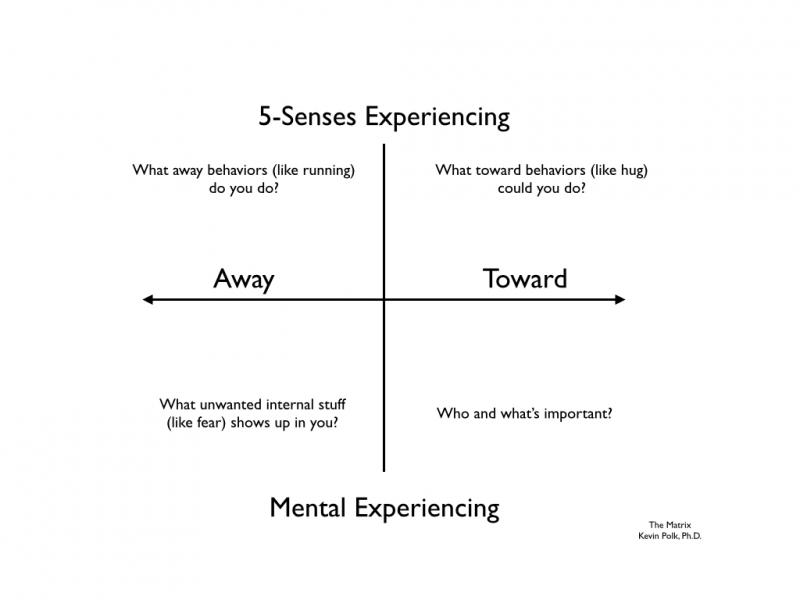
Learning to use the Matrix is experiential and much the same as learning to ride a horse, or a bike, or play the piano, or paddle a kayak. It is a simple idea that can be learned very quickly but takes a little time and practice to become proficient. Mainly people practice learning to notice where behaviors are taking them, and to align that with what is important. The simplicity of the model means that it is broadly applicable and can be used outside of the clinical setting, for instance it is already used in education and in the workplace. It's been used in Sierra Leone to help combat the spread of the Ebola virus and in prisons to help inmates improve value consistent behaviors.
Read more about Polk's work on his Psychological Flexibility Blog.
Check out the free ACT Matrix Course here...
Mark Webster has also created a 3 part video series introducing the ACT Matrix which can be found here:
To Learn more also see Kevin Polk's training page as well as his Website.
Click here for upcoming workshops and trainings.
Below you will find various handouts and .pdfs about the matrix cultivated from trainings anf conference presentations.
Charlie Laurel ACT Videos
Charlie Laurel ACT VideosI created these four videos on the ACT matrix to help my professional colleagues use the matrix with compassion and flexibility. The first video goes through the basic description; the second presents a made-up case to illustrate use; the third presents some of the insights that can emerge from matrix work; the fourth is an experiement with a double matrix to illuminate the complexity of moving toward change when two people are interacting, and possibilites to break unworkable cycles of behavior. I hope you find them useful.
Charlie Laurel, MS, LCMHC
Kevin Polk Page
Kevin Polk PageAn Introduction to ACT- for Rapid Behavior Change

The Matrix represents the two primary mechanism of change in ACT that are called Perspective Taking and Behavioral Analysis. Unlike typical behavioral analysis in which a practioner does the analysis, in ACT we teach the client to do her or his own analysis. In it's simplest form, the person learns to notice behaviors that move Toward values or Away from unwanted experiencing. Both Toward and Away moves are essential to life, it's the combination of the moves over time that add up to living a relatively stuck life, or one that is moving toward values. Said another way, it's a way of noticing a combination of behaviors that work for living a valued life.
You can use the Matrix a million different ways. Below is a video course about Psychology Flexibility Training that can be presented to community groups.
I offer online and telephone training to professionals doing mental health or process improvement work.
You can contact me or visit the website at www.drkevinpolk.com for more information.
A great way to get started with the Matrix is the Visual Wellness Plan.
You can get the "Visual Wellness Plan" manual by clicking here.
Be well,
Kevin
Learning the Matrix
Learning the MatrixThe Matrix is a simple method for teaching clients to understand the function of their behaviors (e.g., avoidance/escape versus moving toward values) as well as discriminate between events within and outside the skin (e.g., mental experiencing and direct experience). It was created by Kevin Polk, Mark Webster, and Jerold Hambright.
Here are links to three videos (on Youtube) that details the Matrix and demonstrates how to use it.

http://www.youtube.com/watch?

http://www.youtube.com/watch?

http://www.youtube.com/watch?
Attached to this page is a companion document that walks you through using it with clients.
The MATRIX Worksheet w/ Fill in Blanks and Excel Codes
The MATRIX Worksheet w/ Fill in Blanks and Excel Codes pmcnulty1000The Matrix in Swedish
The Matrix in SwedishACT-matrisen är ett sätt att ge ACT. För att läsa mer om ACT-matrisen rekommenderas “The ACT Matrix” och “The Essential Guide to the ACT Matrix”. Den senare boken har fått stå som förlaga till denna svenska anpassning. Thor Bengtsson är alltså inte upphovsman till The ACT Matrix men har stått för denna översättning och anpassning till svenska. Det kan vara svårt att förstå denna svenska bearbetning helt och hållet om man inte läst åtminstone den senare boken. Utöver ovanstående läsrekommendationer är det viktigt att behärska ACT i allmänhet och även vara förtrogen med patient/klientgruppen. Handledning föreslås till den osäkre och även ibland för den säkre.
I sex steg ger vi deltagarna kraftfulla verktyg att själv kunna relatera till och hantera till sina problem. De sex stegen är som följer:
Presentation av matrisen, en sortering av beteenden i en fyrfältare med axlarna “Till och Från” och “Inre och Yttre”.
Funktionell analys av problembeteenden (Att jämföra med, ABC, T-K-H eller SORK)
Medvetandegörande av problembeteenden (Metafor: Att inte bita på krokar)
En modell med verbala hjälpmedel för att applicera svåra situationer på ACT-matrisen och inte fastna i problembeteenden (Metafor: Verbal Aikido)
Self-Compassion (här har det blivit störst förändringar mot förlagan)
Träning i perspektivtagande (Att ta perspektiv med sig själv vid andra tidpunkter)
Materialet finns nedan
Observera att uppdateringar sker löpande.
The Survival-Vital Matrix
The Survival-Vital MatrixA spin on the traditional ACT Matrix.
Attached is a quick-guide to the S-V Matrix, and more information can be found here: https://www.theactmatrix.com/pages/trauma
And here is a video elaborating on this version: https://youtu.be/hTJXPYRYI5s
The matrix in spanish
The matrix in spanishBelow is a version of the matrix in spanish. Enjoy! Fabián
The ACT Matrix for Intake Sessions
The ACT Matrix for Intake SessionsHere's how to use the ACT Matrix for the first time with a client, including scripts of how to phrase things.
It covers creative hopelessness, goal setting, therapeutic alliance and tips and tricks to setting up the ACT Matrix in a clear and comprehensive way.
The ACT Roadmap - A Free Guide for getting started with ACT
The ACT Roadmap - A Free Guide for getting started with ACTThe ACT Roadmap is a FREE 28 page Ebook for learning about Acceptance and Commitment Therapy (ACT).
With its colourful design, this digestible guide teaches you about ACT practice's head, hands, and heart. You'll learn about Contextual Behavioural Science (CBS), the home of ACT, receive guidance on treatment, supervision and relevant resources to build your knowledge and skills.
Written by Jim Lucas, ACBS Peer-reviewed ACT Trainer.
You can download a FREE copy here.
The ACT Roadmap is available in Portuguese: Roteiro ACT - Guia de Introdução à Terapia de Aceitação e Compromisso
Trichotillomania
TrichotillomaniaThe protocol is available in book form in
Woods, D. W., & Twohig, M. P. (2008). Trichotillomania: An ACT-enhanced Behavior Therapy Approach Therapist Guide. Oxford University Press.
The accompanying client workbook is available in
Woods, D. W., & Twohig, M. P. (2008). Trichotillomania: An ACT-enhanced Behavior Therapy Approach Workbook. Oxford University Press.
Experimental tests to date:
Woods, D. W., Wetterneck, C. T., & Flessner, C. A. (2006). A controlled evaluation of Acceptance and Commitment Therapy plus habit reversal for trichotillomania. Behaviour Research and Therapy, 44(5), 639-656.
Values List & Tool
Values List & ToolFrom Ellie Miller:
I've created a simple Values List PDF and an Interactive Online Tool to help your clients pinpoint what's truly important to them.
These easy-to-use resources are great for guiding clients through ACT values clarification, whether as part of homework or during live sessions via screen sharing.
They're practical, straightforward, and ready to be integrated into your work. Give them a try and see how they can support your clients' progress.
Check it out here → Values List & Interactive Tool
 (2 x 2.5 in).png)
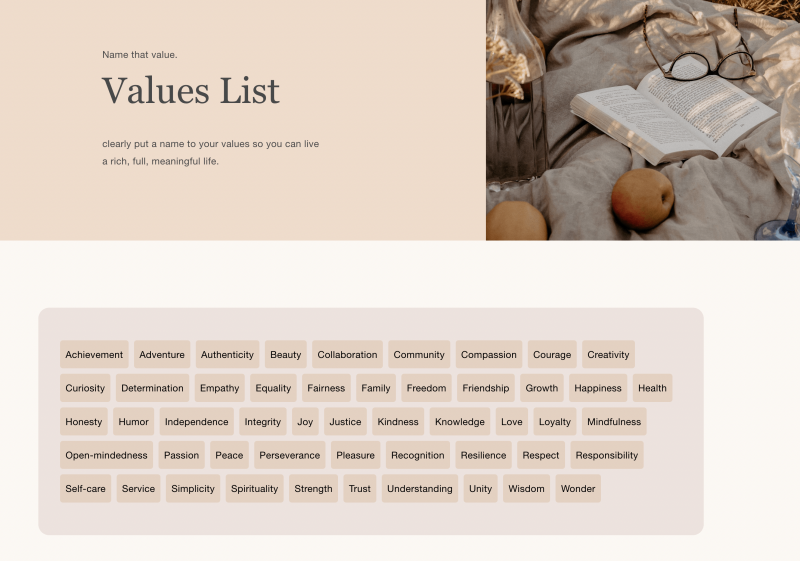
100+ ACT Journal Prompts
100+ ACT Journal PromptsElevate your clients' reflective practice with our expansive collection of over 100 ACT-themed journal prompts. Designed to inspire deeper self-exploration and align with core ACT principles, this generator is an invaluable tool for therapists seeking to enrich their clients' homework and session work. It’s a perfect resource for sparking meaningful insights and facilitating personal growth, available at your fingertips.
→100+ ACT Journal Prompts for Self Reflection

Visual Aid for explaining how the Observing Self relates to our brain
Visual Aid for explaining how the Observing Self relates to our brainHi,
I have adapted some slides from Dr Janina Fisher- to explain how making contact with our Observing Self can help dampen the effects of our Amygdala on our FIght/flight responses. I hope that you find them useful. I would be most welcome to feedback.
Kind regards,
Campbell
Weight Maintenance
Weight MaintenanceExperimental tests:
Lillis, J., Hayes, S. C., Bunting, K., & Masuda, A. (2009). Teaching acceptance and mindfulness to improve the lives of the obese: A preliminary test of a theoretical model. Annals of Behavioral Medicine, 37, 58-69.
Below is a protocol for a 1-day workshop for weight-related stigma and weight maintenance based on Acceptance and Commitment Therapy developed by Jason Lillis, Steven Hayes, and Kara Bunting.
Worksite Stigma and Burnout
Worksite Stigma and BurnoutThis is a protocol designed to reduce entanglement with stigmatizing thoughts about clients and through that reduction in burnout and stress at work.
Experimental tests:
Hayes, S. C., Bissett, R., Roget, N., Padilla, M., Kohlenberg, B. S., Fisher, G., Masuda, A., Pistorello, J., Rye, A. K., Berry, K. & Niccolls, R. (2004). The impact of acceptance and commitment training and multicultural training on the stigmatizing attitudes and professional burnout of substance abuse counselors. Behavior Therapy, 35, 821-835.
The protcol is for a 6 hour group workshop. It is not very detailed -- refering in a single line to exercises that might take 40 minutes. For those familiar with experiential ACT workshops, this should be enough. You will see most of these exercises at major ACT / RFT conventions such as the World Conferences or the Summer Institutes.
This protocol is currently being revised for a large new grant (which will run from 2005 to 2008) that will replicate and extend the study above. It is our sense that we can do better than the protocol that is here, so don't feel bound by it. Use it as a starting point.
The adherence manual include both ACT and Multicultural Training items since that was the comparision in the study (and in this new grant ... which will include an ACT and MT combination group as well as ACT alone and MT alone and a control).
For more information contact Steve Hayes (hayes@unr.edu), Department of Psychology, University of Nevada, Reno, NV 89557-0062
Worksite Stress Interventions
Worksite Stress InterventionsExperimental tests to date:
Bond, F. W., & Bunce, D. (2000). Mediators of change in emotion-focused and problem-focused worksite stress management interventions. Journal of Occupational Health Psychology, 5, 156-163.
The protocol itself can be found in Bond, F., & Hayes, S. C. (2002). ACT at work. In F. Bond & W. Dryden (Eds.), Handbook of Brief Cognitive Behaviour Therapy (pp. 117-140). Chichester, England: Wiley.
For further information contact: Frank Bond (f.bond@gold.ac.uk), Department of Psychology, Goldsmiths College, University of London, New Cross, London SE14 6NW
Worksite stress interventions II: Brief ACT-enhanced MBI for hospital ward staff
Worksite stress interventions II: Brief ACT-enhanced MBI for hospital ward staffThis course was designed for frontline hospital staff who were unable to attend a standard 8-week course in working hours, because of workload/staffing pressures. The course was delivered as 8 half-hour sessions WITHIN the hospital ward, in a quiet room, whilst their colleagues willingly covering their duties. The approach is based on MBCT, ACT and a self compassion exercise (made by combining ACT metaphor with an exercise provided by Choden and Paul Gilbert).
1 page Summary course overview is given in poster format below
Materials for the 8-week course, are supplied, organised by week. (Plus Week 0, which was the taster session). Includes all course materials, scripts, teacher timetables (we needed detailed timings because each session was only half an hour long, and we kept to these timings so that clinical work was not affected); we've also included a few reflections on how sessions went and how we'd do it differently next time, and equipment checklists. Mp3s for raisin and chocolate meditations are provided, and the other audio tracks are available with the course handbook (Peace in a Frantic World, Mark Williams and Danny Penman).
Measures: Another time, we would probably use different pre and post measures (these were selected based on local factors), e.g. GHQ12; the written qualitative questions yielded a lot of useful information; also staff were keen to express their thoughts in a facilitated meeting with the Senior HR manager Antony who championed the pilot.
Please feel free to use and adapt
Margo Campbell (ACBS member), Richard Hawkins, Antony Cobley (not ACBS members)
Young Children
Young ChildrenExperimental tests to date: None Published For further information contact: Amy Murrell (amurrell@unt.edu) or Kelly Wilson (kwilson@olemiss.edu), University of Mississippi. Author's note: We are posting this protocol in the hope that they will provide useful information in helping clients and spark further interest and research in ACT with children and adolescents. Please, recognize that we consider the treatment technology to be evolving in nature. These protocols, therefore, should be viewed as works in progress. The underlying principles should be adhered to, but the protocols can (and indeed should) be used with flexibility.